











Rituals
Gayatri Upasana: Practical Dimensions of Mantra Japa
Within the soteriological framework of the Vedic and Tantric traditions, japa the disciplined, repetitive vocalization or mental contemplation of a sacred formula is not merely an act of devotional supplication, but a sophisticated spiritual science.
 By Prerak "प्रेरक"
14 min read
By Prerak "प्रेरक"
14 min read

The Sonic Hierarchy of Gayatri Upasana: Scriptural, Metaphysical, and Practical Dimensions of Mantra Japa
The Metaphysical Foundation of Japa Yoga
Within the soteriological framework of the Vedic and Tantric traditions, japa the disciplined, repetitive vocalization or mental contemplation of a sacred formula is not merely an act of devotional supplication, but a sophisticated spiritual science. Historically defined by the great Kashmiri Shaiva philosopher Abhinavagupta in his Tantrasara as aksharavrittih (the systematic repetition of letters or phonemes), japa serves as the primary mechanism to align individual human consciousness with the cosmic, absolute reality. Through the persistent oscillation of these sacred sound patterns, the practitioner builds a continuous wave of spiritual energy that tames the erratic fluctuations of the mind, preparing the internal landscape for deep meditative absorption (samadhi).
This spiritual technology is traditionally categorized into three fundamental vectors of power: mantra shakti (the latent vibrational power inherent within the specific sonic arrangement of the formula), devata shakti (the cosmic intelligence or deity invoked), and sadhana shakti (the focused willpower and intentionality of the practitioner). When these three vectors intersect, they elevate japa to the status of an internal sacrifice, or japa yajna. Both the Bhagavad Gita (10:25) and the Manu Smriti (II:85-86) declare japa yajna to be the highest of all sacrifices, surpassing external ritualism.
                               (Sonic Vibration)
                                      /\
                                     /  \
                                    /    \
                                   /      \
                                  /________\
                  (Cosmic Intelligence)   (Practitioner's Will)
The superiority of japa yajna over external offerings is rooted in its internalization of the sacrificial fire. In traditional Srauta and Smarta rituals, offerings are poured into physical consecrated fires; in japa, the oblations of sacred sound are poured directly into the inner fire of the spirit. The Manu Smriti (2.86) emphasizes this by stating that the four traditional cooked offerings (paka-yajnas), which are associated with the five great daily sacrifices (mahayajnas—including devayajna, pitryajna, bhutayajna, and manushyayajna), along with the complex public sacrifices (vidhi-yajnas), are not worth a sixteenth part of the spiritual efficacy of a properly executed japa yajna.
This efficacy is further refined by the ethical orientation (guna) of the practice. Selfless recitation aimed solely at spiritual liberation is classified as sattvic; chanting driven by the pursuit of material wealth or worldly power is rajasic; and any recitation intended to inflict harm or manipulate others through negative occult rites is deemed tamasic.
As the sadhaka (practitioner) advances along the sattvic path, the effort of conscious chanting transitions into ajapa-japa the spontaneous, subconscious, and continuous resonance of the mantra within the subtle nervous system, persisting day and night without conscious exertion.
Furthermore, the application of japa is structured according to the practitioner's intent and obligations, classified into various operational categories:
- Nitya Japa: The daily, non-negotiable spiritual duty performed to maintain psychic purity and fulfill cosmic obligations.
- Naimittika Japa: Occasional recitations mandated by specific astronomical alignments, festivals, or purification rites, such as the Shravan Pournamee.
- Kamya Japa: Recitations undertaken with a formal vow (sankalpa) to achieve a specific, desired material or mundane result.
- Prayshchitta Japa: Expiatory chanting performed to neutralize the karmic residue of voluntary or involuntary transgressions.
- Achala Japa: Recitation bound to a fixed time, posture, and sacred space to maximize energetic accumulation.
- Chala Japa: The informal, continuous repetition of the mantra while walking, working, or traveling, which helps sustain spiritual awareness amidst worldly duties.
- Akhanda Japa: Uninterrupted, continuous chanting maintained over an extended duration, often executed by a community of practitioners.
The Canonical Structure and Cosmological Mappings of the Gayatri
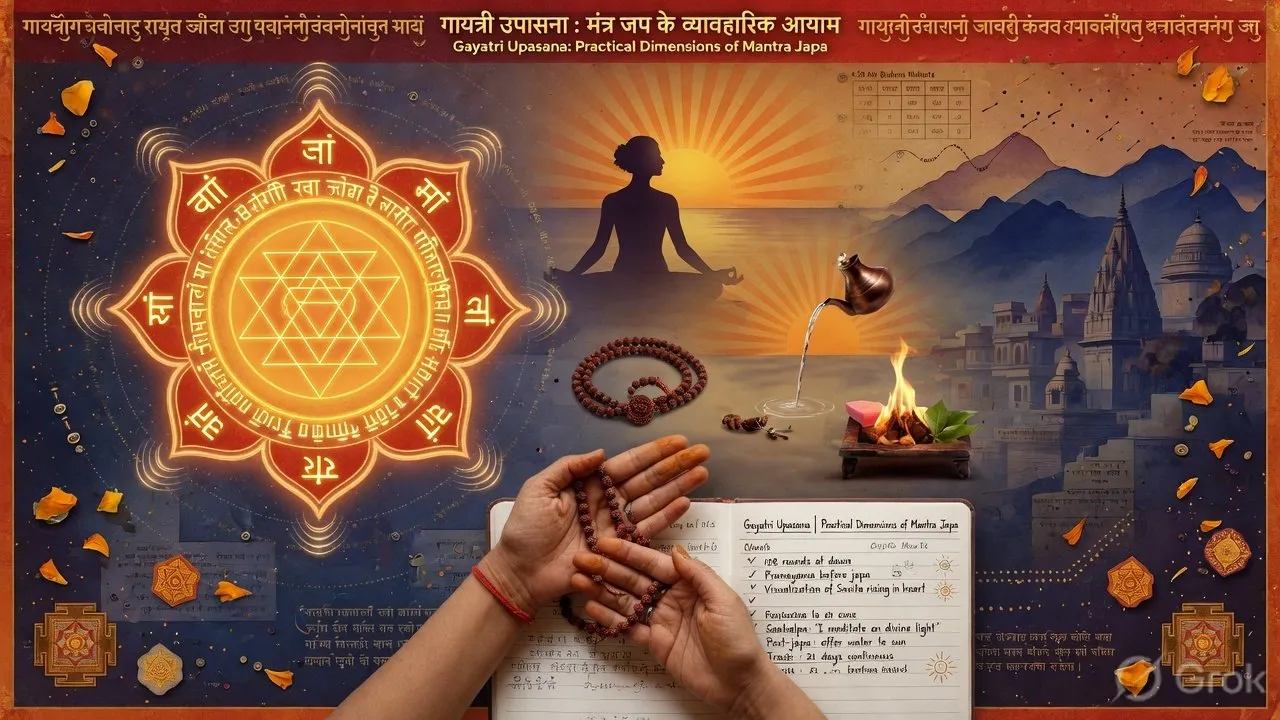
The preeminent formula of the Vedic corpus is the Gayatri Mantra, also known as the Savitri Mantra. Preserved in the Rig Veda (3.62.10) and attributed to the vision of Brahmarshi Vishwamitra, it is structurally cast in the twenty-four-syllable Gayatri metre.
In its complete, ritualistic form, the mantra is prefixed by the sacred syllable Om and the three mystical utterances known as the Mahavyahriti (Bhur, Bhuvah, Svah), which were extracted from the core of the three Vedas by the creator-god Prajapati.
                     [OM] (Primordial Transcendence)
                             |
              +--------------+--------------+
              |              |              |
          (Physical)    (Atmospheric)  (Celestial)
              |              |              |
              +--------------+--------------+
                             |
                   (24-Syllable Body)
The complete Devanagari orthography and its phonetic transliteration are presented below :
ॐ भूर्भुवः स्वः तत्सवितुर्वरेण्यं भर्गो देवस्य धीमहि धियों यो नः प्रचोदयात् ॥
Om Bhur Bhuvah Svah | Tat Savitur Vareṇyam | Bhargo Devasya Dhīmahi | Dhiyo Yo Naḥ Prachodayāt |
Within the structural constraints of Vedic prosody, the Gayatri metre consists of three feet (tripada) of exactly eight syllables each. However, a literal reading of the written Devanagari text reveals a potential phonetic deficit in the first foot :
Tat Sa-vi-tur Va-re-ṇyam} (yields only 7 syllables)
To resolve this discrepancy and maintain the strict twenty-four-syllable meter required to activate the mantra's spiritual power, ancient commentators and modern practitioners note that the word Vareṇyam must be phonetically expanded during recitation :
Tat Sa-vi-tur Va-re-ṇi-yam (yielding the canonical 8 syllables)[8, 11]
Linguistic debates on contemporary forums highlight this exact point. On the spiritual blog Petals from the Heart, practitioners discuss this pronunciation, noting that extending the 'e' sound or articulating it as "Vareenyam" or "Vareniyam" is essential to align the chant with its mathematical and cosmological template. This structural precision is directly connected to the cosmological extraction process detailed in the Taittireeya Aranyaka and the Upanishads, where Prajapati brooded over the cosmos to distill its ultimate essence :
| Cosmological World | Consecrated Fire / Deity | Source Scripture | Extracted Mahavyahriti | Metaphysical Plane / State |
| Earth (Prithvi) | Agni (Physical Fire) | Rig Veda | Bhuh |
Waking Consciousness / Physical Body (Sat) |
| Atmosphere (Antariksha) | Vayu (Pranic Wind) | Yajur Veda | Bhuvah |
Dream Consciousness / Mental Vehicle (Chit) |
| Heaven (Swarga) | Aditya (Solar Light) | Sama Veda | Svah |
Deep Sleep / Spiritual Body (Ananda) |
Linguistic and phonetic systems are further illuminated by the ancient semantic skeptics, most notably Kautsa Muni. Kautsa argued that the primary efficacy of a mantra does not reside in its semantic meaning, which is often simple, but rather in its precise phonetic architecture. This is particularly true of the Gayatri Mantra: while its semantic meaning is a straightforward prayer for intellectual illumination, its phonetic arrangement is a highly complex sonic formula. The specific combination of syllables is engineered to generate ultra-sound waves upon recitation, stimulating the physical body's energy centers and activating subtle channels within the nervous system.
To satisfy various theological needs, the Vedic tradition later developed secondary Gayatri formulas dedicated to other aspects of the Divine. These formulas maintain the twenty-four-syllable meter and the tripartite structure of the original solar Gayatri :
| Presiding Deity | Liturgical Gayatri Sanskrit Text | Liturgical Gayatri English Transliteration |
| Ganesha | एकदन्ताय विद्महे वक्रतुण्डाय धीमहि तन्नो दन्ती प्रचोदयात् ॥ |
Ekadantaya Vidmahe Vakratundaya Dhimahi Tanno Danti Prachodayat |
| Durga | कात्यायनाय विद्महे कन्याकुमार्यै च धीमहि तन्नो दुर्गाय प्रचोदयात् ॥ |
Kathyayanaya Vidhmahe Kanya Kumari Cha Dheemahe Thanno Durgaya Prachodayath |
| Lakshmi | महादेव्यै च विद्महे विष्णुपत्न्यै च धीमहि तन्नो लक्ष्मी प्रचोदयात् ॥ |
Mahadevyaicha Vidhmahe Vishnu Pathniyaicha Dheemahe Thanno Lakshmi Prachodayath |
| Saraswati | वाग्देव्यै च विद्महे विरिञ्जपत्न्यै च धीमहि तन्नो वाणी प्रचोदयात् ॥ |
Vakdeviyai Cha Vidhmahe Virinji Pathniyai Cha Dheemahe Thanno Vani Prachodayath |
| Shiva | तत्पुरुषाय विद्महे महादेवाय धीमहि तन्नो रुद्र प्रचोदयात् ॥ |
Om Tat Purushaya Vidhmahe Mahadevaya Dheemahe Thanno Rudra Prachodayath |
| Narayana | नारायणाय विद्महे वासुदेवाय धीमहि तन्नो विष्णु प्रचोदयात् ॥ |
Om Narayanaya Vidhmahe Vasudevaya Dheemahe Thanno Vishnu Prachodayath |
| Sathya Sai | सायिेश्वराय विद्महे सत्यदेवाय धीमहि तन्नो सर्वः प्रचोदयात् ॥ |
Sayeeshwaraya Vidmahe Satyadevaya Dhimahi Tanno Sarvah Prachodayat |
The Tripartite Taxonomy of Vocalization: Is Gayatri "Upanshu"?
To understand whether the Gayatri Mantra should be chanted silently, whispered, or aloud, we must examine the scriptural taxonomy of vocalization (japa) and how these practices relate to different levels of human consciousness.
                     (Intellectual / Visualized)
                               Efficacy: 1000x
                                     ^
                                     |
                    (Mental / Whispered)
                               Efficacy: 100x
                                     |
                     (Physical / Audible)
                               Efficacy: 10x
                                     |
                (Standard Physical Sacrifice)
                               Efficacy: Baseline (1x)
This phonetic scale is defined by Medhatithi in his commentary on the Manu Smriti (2.85), establishing a clear relationship between the degree of vocal internalization and the resulting spiritual potency :
Potency of Japa} (Manasa)>> (Upanshu) >>(Vaikhari)>>(Vidhi\ Yajna)
According to the canonical decrees of Manu Smriti (2.85) and the commentaries of Medhatithi, the exact values of these different vocal methods are defined mathematically :
(Vaikhari) = 10 (Vidhi\ Yajna)
(Upanshu) = 100 (Vidhi\ Yajna)
(Manasa) = 1000 (Vidhi\ Yajna)
Vaikhari (or Vachika) represents loud, audible chanting. Here, the sound waves are fully projected into the physical plane through the movement of the throat, tongue, and lips. This method corresponds to physical consciousness, and while highly useful for anchoring the restless mind of beginners, it remains the most externalized form of practice.
Upanshu represents whispered recitation. In this state, only the lips move slightly, and the sound is kept completely inaudible to anyone nearby. This represents a shift to mental consciousness (madhyama), where the focus begins to turn inward.
Manasa (or Manasika) represents purely silent, mental recitation. In his work The Ancient Science of Mantras, Om Swami emphasizes that true Manasa japa is not simply screaming the mantra silently within the mind. Rather, it is the focused, sequential visualization of each syllable of the mantra in the mind's eye. This visual and cognitive recall accesses the intellectual plane of consciousness (pashyanti), making it the most potent and challenging form of japa.
The Secret vs. Public Debate: Is the Gayatri inherently Upanshu?

The question of whether the Gayatri Mantra must be performed as Upanshu reveals two distinct views within the tradition:
-
The Esoteric/Lineage Directive: Orthodox traditions and several modern spiritual lineages, such as the Gaudiya Vaishnava tradition under Srila Prabhupada, maintain that the Gayatri is a highly confidential formula that must never be chanted loudly or in public spaces. They argue that because it is a diksha (initiated) mantra, it must be recited in absolute silence (Manasa) or whispered so quietly (Upanshu) that it is kept safe from unauthorized hearing. In this view, loud public chanting or broadcasting the mantra violates its inner sanctity.
-
The Universal/Vedic Counter-Argument: Conversely, organizations like the All World Gayatri Pariwar (AWGP) argue that the strict requirement of secrecy is a medieval development rather than an original Vedic mandate. They point out that the etymology of "Gayatri" itself (gai + tra) means "the song that protects". Traditional Vedic recitations were naturally chanted aloud with precise musical notation to elevate the environmental vibration. They assert that keeping the mantra secret was a socio-cultural gatekeeping mechanism used to maintain exclusive control over spiritual authority.
The Practical Synthesis
These perspectives are resolved through a developmental model of practice. Beginners, especially children, are encouraged to start with Vaikhari (audible chanting) to establish correct pronunciation, master the rhythm, and keep the mind focused.
As the practitioner becomes comfortable with the mantra, they naturally transition to Upanshu (whispered chanting), which deepens concentration and internalizes the energy.
Finally, the seasoned practitioner progresses to Manasa japa, repeating the mantra in silent mental visualization during deep meditation. However, even for advanced practitioners, Upanshu remains the optimal default for daily solitary rituals, while Manasa is reserved for quiet, seated contemplation.
Ritual Orthopraxy and Sandhyavandanam Rules
The performance of the Gayatri Mantra is traditionally set within the structured ritual of Sandhyavandanam. This daily practice is designed to align the practitioner's bio-rhythms with the primary astronomical transitions of the day.
                     (4:00 AM - 6:00 AM)
                          Presiding Form: Gayatri
                                     |
                                  [NOON]
                          Presiding Form: Savitri
                                     |
                         Presiding Form: Saraswati
The specific rules governing sadhana are highly structured across several domains:
Physical and Postural Rules
The practitioner must cleanse the body by bathing, or if unable to do so due to illness, by taking a symbolic sponge bath. One should wear loose, comfortable, and freshly washed clothes.
To begin, the practitioner sits in a comfortable, cross-legged posture with the spine kept strictly erect, which allows prana to flow freely through the central sushumna channel.
Chanting on the bare ground is prohibited, as the physical and spiritual energy generated during japa can easily dissipate into the earth. A mat of kusha grass is considered the most effective for energy retention, with cotton or wool as acceptable alternatives, while specialized woollen or leather carpets are used only in Tantrik practices.
Spatial Multipliers
The spiritual returns of japa are greatly amplified by the physical environment. As detailed in the Devi Bhagavata Purana (Book 11), a single recitation of the mantra yields vastly different spiritual merits depending on where it is practiced :
| Location of Sadhana | Spiritual Potency Multiplier |
| Household / Private Residence |
Baseline (1x) |
| Riverbank or Lake Shore |
2x baseline |
| Cowshed (Goshala) |
10x baseline |
| Yajna Shala / Agni Shala |
100xbaseline |
| Siddhi Kshetra / Punya Kshetra / Temple |
10,000,000x (1 Crore) |
| Sanctum Sanctorum of Vishnu or Devi |
Infinite |
Chronological and Deity Mappings
japa must be performed at the three sandhyas (the junctions of time) :
- Morning Sandhya: Performed during Brahmamuhurta (ideally 4:00 AM to 6:00 AM) facing East, focusing on the sunrise. The deity is visualized as Gayatri, representing Brahmi energy.
- Noon Sandhya: Performed at midday when the sun is at its zenith, facing North or East. The deity is visualized as Savitri, representing Vaishnavi energy.
- Evening Sandhya: Performed at sunset, facing West. The deity is visualized as Saraswati, representing Shivani energy.
Standard sadhana must be completed during the day, as non-Tantrik chanting is generally prohibited during the night.
Rosaries and Counting
To maintain focus without mental strain, practitioners use a rosary (mala) of 108 beads, traditionally made of Tulsi or Sandalwood. Malas of Rudraksha, red-sandalwood, or conch-shell are reserved for Tantrik applications.
When using a mala, the practitioner holds it in the right hand and moves the beads using only the thumb and middle finger, ensuring the index finger never touches the beads.
Alternatively, if a mala is not available, the practitioner can count using the joints of the fingers on the right hand, tracing a pattern from the middle finger toward the index finger in the shape of a snake's head.
Daily Quota and Penance (Prayshchitta)
The standard daily commitment is 108 recitations. If time is limited, one can divide the count across the three junctions: chanting 36 times at dawn, 36 at noon, and 36 at sunset. For deeper purification, advanced practitioners are encouraged to chant 1,008 or even 3,000 to 4,000 times daily.
To maintain consistency, the tradition outlines specific expiatory rules (prayaschitta) for any disruptions. If a practitioner must pause mid-sadhana to answer a call of nature, they must wash their hands and face before resuming, adding one additional mala of chanting as a penance for the interruption. If an entire day of sadhana is missed, the lost quota must be made up the following day to honor the spiritual vow.
This discipline is balanced by a progressive scale of karmic purification, where the sheer volume of recitation is understood to dissolve deep-seated karmic blockages :
| Recitation Volume | Karmic Purification and Absolution Efficacy |
| 1 Single Repetition |
Absolves the immediate sins of the present day |
| 10 Repetitions |
Purifies sins accumulated over the past day and night |
| 100 Repetitions |
Purifies sins accumulated over the past month |
| 1,000 Repetitions |
Cleanses the karmic residue of the entire past year |
| 100,000 (1 Lakh) |
Purifies sins accumulated over the span of the current lifetime |
| 1,000,000 (10 Lakhs) |
Cleanses karmic blockages carried over from the previous birth |
| 10,000,000 (1 Crore) |
Eradicates the accumulated karmic debt of all past lifetimes |
Modern Socio-Spiritual Views, Ethical Guidelines, and the "Vrittic Purge"
As the practice of Gayatri has moved beyond exclusive communities, modern spiritual commentators have addressed contemporary questions regarding gender, lifestyle, and biological integration.
Gender and Demography
The medieval restriction prohibiting women from chanting the Gayatri Mantra is widely rejected by modern spiritual masters, including Sri Ramakrishna Paramahansa, Swami Vivekananda, Sarada Devi, and Sathya Sai Baba. They clarify that spiritual energy operates on a level that is entirely independent of gender or bodily chemistry.
Consequently, traditional restrictions—such as prohibiting women from chanting during their menstrual cycles—have no basis in true spiritual science. The mantra is universal, open to any seeker who approaches it with sincerity, irrespective of gender, caste, or race.
Purity and Lifestyle Integration
On contemporary blogs like Petals from the Heart, practitioners often discuss how to balance regular chanting with the realities of modern life.
- Dietary Choices: Spiritual teachers emphasize that a vegetarian diet is highly recommended for anyone chanting the Gayatri Mantra daily. Because the mantra invokes a universal, radiant life force, consuming food obtained through violence (himsa) creates an energetic conflict that can hinder spiritual progress.
- Sexuality: Addressing questions from newly married practitioners, teachers note that physical intimacy is a natural part of householder life (grihastha). However, one should keep the mind clear of sexual thoughts during active sadhana to preserve mental focus.
- Chanting During Daily Tasks: While structured, seated meditation is the ideal way to perform japa, casual mental chanting (chala japa) during routine tasks like driving or walking is highly encouraged, as it keeps the mind anchored in a positive state throughout the day.
The Phonetic and Biological Impact
Repeating the twenty-four syllables of the Gayatri Mantra has been shown to produce measurable physiological changes in the body. The specific pronunciation of these letters vibrates subtle energy centers along the palate, throat, and skull, which stimulates the pituitary and parathyroid glands.
This phonetic feedback helps regulate endocrine secretion and calm the nervous system. Chanting with a slow, controlled breath also mirrors the benefits of pranayama, helping to lower stress hormones and improve cardiovascular coherence.
Understanding the "Vrittic Purge"
For some practitioners, commencing a high-frequency mantra practice like the Gayatri can occasionally trigger a temporary phase of emotional or mental restlessness. Rather than indicating a negative reaction, this is understood as a "Vrittic Purge".
Just as a potent medicine can cause a temporary healing crisis as the physical body clears toxins, a high-frequency mantra acts as a diagnostic tool in the subconscious mind. It brings deeply suppressed anxieties, anger, and mental noise to the surface to be processed and cleared, gradually paving the way for lasting mental clarity and peace.
                  [High-Frequency Mantra Vibration]
                                 |
                                 V
                                 |
                  +--------------+--------------+
                  |                             |
                    [Vrittic Purge]
       (Anxiety, Anger, Stress)      (Temporary Restlessness)
                  |                             |
                  +--------------+--------------+
                                 |
                                 V
                      [Mental Purification]
                        (Sattvic Clarity)
A complete analysis of scriptural sources and contemporary practices reveals that the Gayatri Mantra is a versatile spiritual tool that should not be restricted to a single, rigid mode of recitation.
-
Vaikhari Japa serves as the essential starting point, helping to establish correct pronunciation, build focus, and ground the mind through audible sound.
-
Upanshu Japa represents the standard, optimal method for daily solitary rituals like Sandhyavandanam, providing a balance between physical articulation and inward concentration while honoring the mantra's sacred nature.
-
Manasa Japa remains the peak of the practice, where physical sound dissolves into pure mental visualization, allowing the practitioner to experience the non-dual radiance of the solar light.
By aligning physical, postural, and temporal guidelines with an understanding of the phonetic science behind the syllables, practitioners can fully unlock the spiritual and physiological power of the Gayatri Mantra, ensuring this ancient Vedic legacy continues to illuminate the human mind.
Keep Reading
View All Articles-
Pooja Cost Table Shri Badrinath Dham & Shri Kedarnath Ji
General darshan at both Shri Kedarnath Dham and Shri Badrinath Dham is free of cost for all devotees
-
Yamuna Pushkaralu 2026 - A Complete Guide
Yamuna Pushkaralu 2026 is a once in 12 years opportunity to take sacred bath in River Yamuna when Jupiter (Guru) enters Cancer (Karka Rashi), energising the river for 12 powerful days from 2 June to 13 June 2026.
-
Guruvayur Temple Festivals Guide
Guruvayur is one of the most vibrant temple towns in India, with festivals almost every month, centred around Guruvayur Sri Krishna Temple in Thrissur district, Kerala (Guruvayur Temple Festivals.).