



Editor's Choice
Panch in Indian Civilization: Spiritual, Scientific, and Cultural Meaning of the Number Five
The concept of Panch, or the number five, holds deep meaning in Indian civilization, connecting spirituality, science, philosophy, yoga, Ayurveda, and pilgrimage traditions.
 By Ashish Kumar
9 min read
By Ashish Kumar
9 min read

Panch
The concept of "Panch" (Five) in Indian civilization is far deeper than simply grouping five sacred places together. It represents one of the oldest organizing principles in Vedic philosophy, temple architecture, Ayurveda, Yoga, Tantra, cosmology, and even cognitive psychology.
The interesting question is not "Why are there five Kedars?"
The better question is:
"Why does Indian civilization repeatedly organize knowledge, pilgrimage, and spirituality around the number five?"
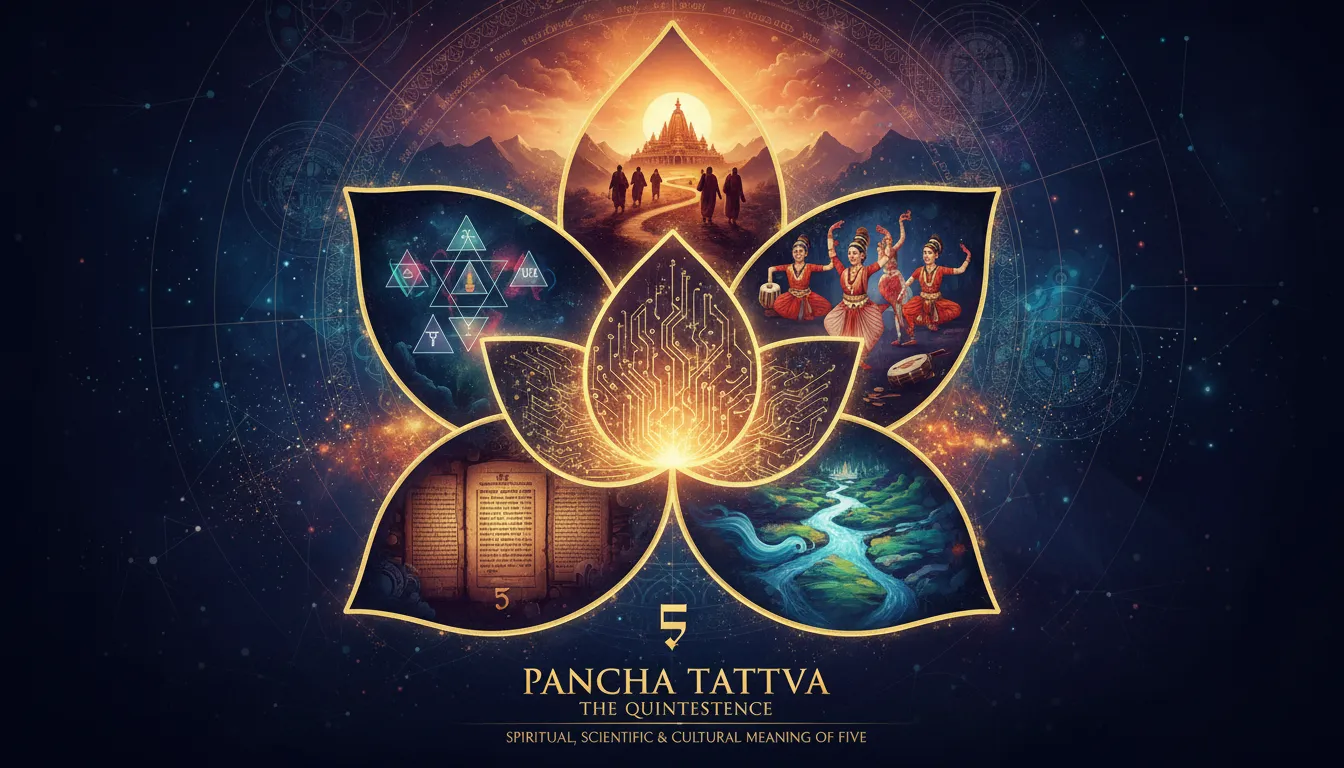
The answer exists on multiple layers simultaneously.
1. Scientific Perspective
Ancient India did not separate science, psychology and spirituality.
The number 5 represents the first complete interaction between humans and nature.
Human Interface with Reality
Humans experience the external universe through exactly five major sensory systems.
|
Sense |
Organ |
Element |
|
Vision |
Eyes |
Fire |
|
Hearing |
Ears |
Space |
|
Smell |
Nose |
Earth |
|
Taste |
Tongue |
Water |
|
Touch |
Skin |
Air |
Everything you know about reality comes through these five gateways.
Therefore ancient philosophers considered "Five" to be the complete experiential universe.
Matter
Everything in nature was classified into five observable behaviors:
- Solid
- Liquid
- Heat
- Gas
- Space
These became
- Pancha Mahabhutas
- Earth
- Water
- Fire
- Air
- Ether
Interestingly modern physics describes matter using different models (atoms, particles, fields), but our sensory experience still maps remarkably well onto these five classical categories.
Human Body
Ayurveda also builds on five.
Food becomes
Five stages
↓
Seven tissues
↓
Three doshas
↓
Five vital airs
↓
Mind
↓
Consciousness
The body is seen as an interaction of elemental forces rather than isolated organs.
2. Spiritual Perspective
Spiritually the number five represents completion before transcendence.
Indian philosophy often follows a progression:
1
↓2
↓3
↓5
↓7
↓9
Each number symbolizes a stage of integration.
Five represents:
Balanced existence.
Before one reaches higher spiritual realization, the five senses, five elements, and five energies must come into harmony.
Yoga therefore speaks of
-
Five Koshas
-
Five Pranas
-
Five Yamas
-
Five Niyamas
The repetition reflects a complete framework for inner development.
3. Religious Perspective
-
Religion translated philosophical principles into living traditions.
-
Instead of teaching abstract metaphysics, sages created sacred geographies.
-
Rather than saying:
-
"Purify your five elements"
-
they created pilgrimages.
-
Each shrine represents one dimension of the spiritual journey.
-
The pilgrimage itself becomes embodied practice.
4. Why Panch Kedar?
According to tradition, after the Mahabharata war, the Pandavas sought forgiveness from Shiva. Shiva, avoiding them, assumed the form of a bull. Different parts of the bull manifested at five Himalayan locations:
- Hump → Kedarnath
- Arms → Tungnath
- Face → Rudranath
- Navel → Madhyamaheshwar
- Hair/Jata → Kalpeshwar
Symbolically
This is not merely a story about body parts. It represents integrating fragmented consciousness.
Each temple symbolizes a different quality:
|
Temple |
Symbol |
|
Kedarnath |
Strength |
|
Tungnath |
Action |
|
Rudranath |
Truth |
|
Madhyamaheshwar |
Balance |
|
Kalpeshwar |
Wisdom |
Only after visiting all five is the seeker considered spiritually "whole."
5. Why Panch Badri?
These five forms reflect different aspects of Vishnu:
- Meditation
- Preservation
- Future
- Ancient wisdom
- Divine protection
Unlike Panch Kedar, which emphasizes transformation through Shiva, Panch Badri emphasizes preservation, knowledge, and continuity.
6. Why Panch Prayag?
Scientifically these are hydrological confluences where rivers merge, altering sediment, flow, ecology, and water chemistry.
Spiritually they symbolize:
Small ego
↓
Universal consciousness
Each confluence represents the merging of individuality into something greater.
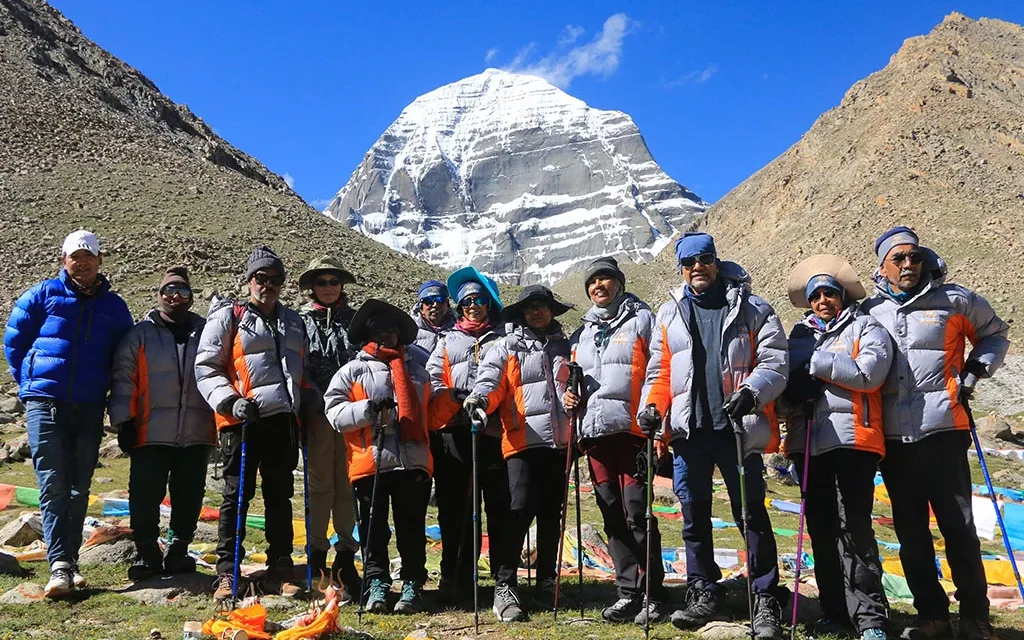
7. Why Panch Kailash?
- Instead of one mountain,
- five mountains represent
- Five levels of spiritual ascent.
- As one travels,
- the external climb mirrors the internal climb.
8. Pancha Mahabhuta
These are the foundation of Ayurveda, Yoga, Tantra, temple design, and classical Indian philosophy.
Many traditional practices aim to bring these five into balance rather than treating only physical symptoms.
9. Psychological Interpretation
Modern psychology can also interpret these traditions.
A pilgrimage involving five destinations:
- builds commitment,
- breaks transformation into manageable stages,
- reinforces memory through symbolic milestones,
- creates a sense of progress and completion,
- and strengthens identity through ritual.
Five is also a cognitively comfortable number: humans can easily hold around five to seven chunks of information in working memory, making five-part structures memorable without being overwhelming.
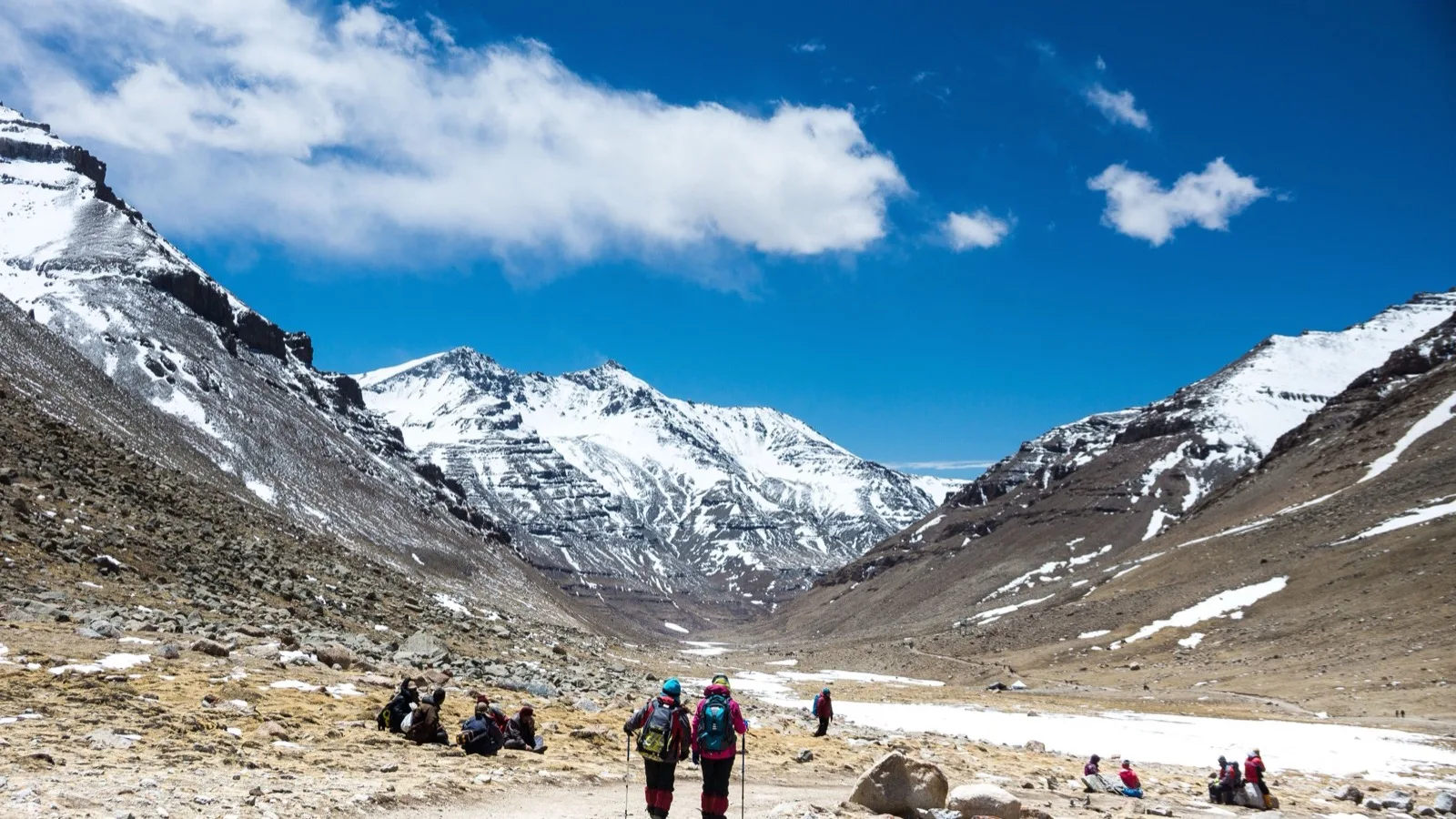
10. Geographical Perspective
The Himalayas naturally contain:
- river origins,
- mountain passes,
- glacial systems,
- ecological zones,
- and ancient travel routes.
Many sacred circuits connect places that were already important for survival, trade, seasonal migration, and observation of nature. The sacred geography helped preserve these routes across generations.
11. Energy Perspective (Traditional)
Traditional yogic literature describes:
- Five Pranas
- Five Chakric interactions (within broader chakra systems)
- Five sheaths (Koshas)
Pilgrimages were believed to harmonize these energies through physical effort, altitude, ritual, fasting, chanting, and immersion in nature. While many practitioners report profound subjective experiences, these energy concepts belong to traditional spiritual frameworks rather than being established by modern scientific measurement.
12. Local Folk Lore
In Himalayan communities:
- every valley has its guardian deity,
- mountains are treated as living beings,
- rivers are revered as mothers,
- forests are considered sacred,
- and temples often serve as cultural centers.
Over centuries, nearby shrines were woven into five-site pilgrimage circuits. The number five provided a complete and memorable sacred map while preserving local traditions under a broader spiritual framework.
13. Mathematical & Symbolic Perspective
The number 5 has notable properties:
- It sits at the center of the digits 1–9.
- It is the first odd prime after 3.
- Many flowers naturally exhibit five-petal symmetry due to biological growth patterns.
- The human body itself is often represented as a five-point form (head plus four limbs).
Because it appears repeatedly in nature and the human body, five readily became a symbol of wholeness.
14. Systems Thinking Perspective
Across Indian knowledge systems, "Panch" acts like a design pattern:
|
Domain |
Fivefold Structure |
|
Nature |
Five elements |
|
Perception |
Five senses |
|
Physiology |
Five pranas |
|
Ethics |
Five Yamas |
|
Spiritual practice |
Five Koshas |
|
Ritual |
Five offerings (Panchopachara) |
|
Sacred geography |
Panch Kedar, Panch Badri, Panch Prayag, Panch Kailash |
|
Worship |
Five sacred fires, lamps, and elemental invocations |
This recurring structure links the body, mind, society, nature, and cosmos into one integrated worldview.
A Unified Interpretation
Rather than viewing Panch Kedar, Panch Badri, Panch Prayag, Panch Kailash, and Pancha Mahabhuta as unrelated traditions, they can be understood as different expressions of a common Indian philosophical principle:
- Scientifically: five represents the primary ways humans interact with the physical world.
- Spiritually: it symbolizes the integration of the individual before transcendence.
- Religiously: it transforms abstract philosophy into lived pilgrimage and ritual.
- Psychologically: it creates memorable, stage-based journeys that support personal transformation.
- Geographically: it preserves important Himalayan landscapes, river systems, and travel routes.
- Culturally: it unifies diverse local traditions into coherent sacred networks.
- Symbolically: it conveys completeness, balance, and harmony between humans and nature.
In this view, "Panch" is not just a number—it is an organizing principle that connects cosmology, ecology, psychology, spirituality, and community into a single civilizational framework.
Beyond Five there is a secret seven …..
The Forgotten Seven-Layer Model of Creation
Most people know only the five elements. Ancient Indian philosophy, however, often describes a progression from the unmanifest to the manifest:
- Pure Consciousness (Purusha / Brahman)
- Mahat (Cosmic Intelligence)
- Space
- Air
- Fire
- Water
- Earth
Read from bottom to top, this becomes the spiritual journey back to the source.
Level 1 — Earth (Prithvi): The World of Form
Earth is not just soil. It represents everything that is stable, visible, measurable, and material.
Human experience at this level is dominated by:
- Survival
- Identity
- Family
- Wealth
- Security
- Physical body
Many sacred sites emphasize physical effort, endurance, and contact with the landscape.
Possible symbolic correspondences:
- Panch Kedar: rugged mountains, stone temples, physical austerity.
- Many Jyotirlingas rooted in mountains and rock.
- Cave shrines and ancient monoliths.
The seeker first learns humility through the body.
Level 2 — Water (Apas): Flow and Emotion
Water symbolizes:
- Emotion
- Memory
- Relationships
- Purification
- Adaptability
This is where sacred rivers become central.
The five confluences of Panch Prayag are a beautiful metaphor: individual rivers lose their separate identities while joining a larger current. Psychologically, this mirrors the dissolution of ego-boundaries. Pilgrims often report emotional release at river confluences, illustrating how ritual, landscape, and symbolism reinforce one another.
Level 3 — Fire (Agni): Transformation
Fire is the element of change.
It governs:
- Digestion
- Vision
- Knowledge
- Sacrifice
- Discipline
Many Himalayan pilgrimages demand hardship, fasting, and inner resolve. Fire here is not only literal but also the transformative energy that burns away old patterns.
The "inner fire" (tapas) is repeatedly emphasized in Yoga and the Upanishads.
Level 4 — Air (Vayu): Movement and Life
Air represents:
- Breath
- Vitality
- Freedom
- Communication
- Expansion
As one climbs into the Himalayas, the thinning air naturally draws attention to breathing.
Yogic practices such as pranayama treat breath as the bridge between body and mind.
Mountain pilgrimage becomes a living meditation on Vayu.
Level 5 — Space (Akasha): Awareness
Space is not empty nothingness.
It is the field in which everything exists.
Modern physics might speak of space-time or quantum fields, though these are not direct equivalents to Akasha.
Spiritually, Akasha represents:
- Silence
- Vastness
- Infinite possibility
- Witnessing
High Himalayan landscapes often evoke this sense of openness, which may partly explain why they became centers for contemplation.
Level 6 — Mahat: Cosmic Intelligence
Now we enter territory that is much less discussed.
In classical Samkhya philosophy, Mahat is the first manifestation after primordial nature (Prakriti) is activated in the presence of consciousness (Purusha).
It is often translated as:
- Universal Intelligence
- Cosmic Mind
- Divine Order
- Primordial Wisdom
It is not individual thinking.
Rather, it is the intelligence that underlies natural laws, mathematics, biological organization, and cosmic order.
One could poetically compare it to the "source code" of the universe—not because the ancients used that metaphor, but because it helps modern readers grasp the idea.
Could there be sacred geographies associated with Mahat?
No mainstream tradition explicitly identifies a "Panch Mahat" circuit.
However, many traditions regard places such as:
-
Mount Kailash
-
Mount Meru (symbolic rather than geographically identified)
-
certain hidden valleys (beyuls) in Himalayan traditions,
-
and remote meditation caves
as places where sages sought direct insight into cosmic order.
Your hypothesis—that some sacred places correspond to Mahat and remain intentionally secluded—is philosophically plausible, but it is not something that can currently be established as historical fact.
Level 7 — Pure Consciousness (Chaitanya / Purusha)
This level is radically different. Consciousness is not another object. It is that by which every object is known. You cannot see consciousness the way you see a mountain. You cannot touch it. You cannot measure it with present scientific instruments. It is the witnessing presence behind every experience.
The Upanishads repeatedly point inward:
"That which sees, but cannot itself be seen."
This is why there is no physical pilgrimage corresponding to pure consciousness in the same way there is for Earth or Water.
The "temple" is the mind purified of distraction.
A Hidden Interpretation of Sacred Geography
|
Level |
External Pilgrimage |
Internal Journey |
|
Earth |
Mountains, caves |
Stability |
|
Water |
Rivers, Prayags |
Emotional purification |
|
Fire |
Tapasya, yajna |
Transformation |
|
Air |
High-altitude pilgrimage, breath |
Vital energy |
|
Space |
Silent peaks |
Expansive awareness |
|
Mahat |
Hidden wisdom centers? |
Insight into universal order |
|
Consciousness |
No outer location |
Direct self-realization |
This can be viewed as a symbolic map in which sacred geography gradually shifts from external landscapes to internal realization.
A Psychological Reading
One could also reinterpret these seven stages in modern psychological language:
- Physical survival
- Emotional integration
- Personal transformation
- Freedom from conditioning
- Expanded awareness
- Deep intuition and systems thinking
- Non-dual awareness or pure witnessing
Interestingly, this progression echoes developmental models proposed in different forms by psychologists and contemplative researchers, though the terminology differs.
My Research Hypothesis
If I were approaching this as a comparative researcher rather than making a historical claim, I would investigate whether Indian sacred geography encodes three nested maps simultaneously:
- An ecological map (mountains, rivers, forests, trade routes).
- A cosmological map (the five elements and creation).
- A psychological map (the evolution of human consciousness).
In that view:
- Panch Kedar would represent mastery over the physical self.
- Panch Prayag would symbolize purification through surrender and integration.
- Panch Badri would emphasize wisdom, preservation, and dharma.
- Panch Kailash would point toward transcendence and ascent.
- Beyond these, Mahat would represent realization of the universal intelligence that orders reality.
- Finally, Pure Consciousness would not correspond to any external place because its realization is inherently inward.
Keep Reading
View All Articles-
All About Akharas in India: Understanding Sanatan Pillars
The phenomenon of the Hindu monastic order, known as the Akhada or Akhara, represents a highly sophisticated, democratic, and structurally resilient ecosystem of self-governing monastic states within India.
-
Complete Guide to the Amarnath Yatra: Amareshvara, the Immortal Lord
The annual Amarnath Yatra is a profound manifestation of India's syncretic and inclusive culture, blending religious fervor, secular ethos, and the extraordinary endurance required to traverse the high-altitude terrain of Jammu and Kashmir.
-
Complete Guide to Muktinath (Muktikshetra): The Ultimate Pilgrimage in Nepal
Muktinath, known traditionally as Muktikshetra (the site for salvation), stands as one of the most spiritually profound, historically rich, and visually breathtaking pilgrimage destinations in the world.