







Spiritual Guides and Gurus
Swami Avdheshanand Giri : Chief "Sri Panch Dashnam Juna Akhara"
His leadership of India's largest and most ancient monastic order of ascetics illustrates a strategic shift in the role of the modern sannyasin transitioning from secluded cave-dwelling contemplation to active participation in global interfaith diplomacy
 By Raj K. Vashyan
15 min read
By Raj K. Vashyan
15 min read

The intersection of ancient ascetic traditions and modern civic engagement represents a dynamic frontier in contemporary Sanatan Dharma. At the center of this evolutionary trajectory is Swami Avdheshanand Giri Ji Maharaj, the Acharya Mahamandaleshwar of Sri Panch Dashnam Juna Akhara. His leadership of India's largest and most ancient monastic order of ascetics illustrates a strategic shift in the role of the modern sannyasin transitioning from secluded cave-dwelling contemplation to active participation in global interfaith diplomacy, ecological preservation, and structured social welfare. This article sees the life, monastic ascension, philosophical framework, socio-civic institutions, and ecological initiatives of Swami Avdheshanand Giri, evaluating how his leadership has modernized monastic governance while preserving the traditional structures of the Dashanami Sampradaya.
Monastic Heritage and Institutional Framework of Juna Akhara
Sri Panch Dashnam Juna Akhara is historically documented as the largest and most ancient monastic order for Naga Sadhus in India. Dating back to its traditional founding in 1146 CE as Juna, its members were historically recognized as Bairagis before formally aligning with the Dashanami Sampradaya established by Adi Shankaracharya. Administratively, Juna Akhara maintains its primary headquarters at Baba Hanuman Ghat in Varanasi, Uttar Pradesh, and worships Lord Dattatreya as its patron deity. The internal configuration of the Akhara is immense, comprising over 200,000 active members or upwards of five million sanyasis within its broader spiritual fold, representing approximately 80 percent of the collective strength of all recognized monastic akharas in India.
Structurally, Juna Akhara is divided into fifty-two distinct organizational lines. This includes sixteen distinct lines of the Puri tradition, fourteen plus two lines of the Giri tradition, four lines of the Bharati tradition, four lines of the Saraswati tradition, and eleven lines of the Lama tradition. The presence of these eleven Lama lines represents a unique historical integration, acknowledging Tibetan lamas of the Padmasambhava lineage within the formal structure of the Akhara.
The leadership hierarchy is strictly formalized. Senior ascetics who demonstrate deep spiritual realization and ascetic discipline are conferred the prestigious title of Mahamandaleshwar, giving them authority over specific spiritual districts or networks of mathas. Above this tier is the Acharya Mahamandaleshwar, who serves as the paramount spiritual and temporal head of the entire Akhara. All saints of the Juna Akhara collectively appointed Swami Avdheshanand Giri to this premier position during the Haridwar Kumbh Mela in 1998. Since his ascension, he has initiated between one million and one point two million Naga sadhus, acting as their first Guru and paramount spiritual guide.
Early Life, Educational Pursuits, and Ascetic Awakening
Swami Avdheshanand Giri was born in 1962 in Khurja, located in the Bulandshahr district of Uttar Pradesh, India, into an orthodox Brahmin family. From early childhood, his development deviated significantly from typical patterns. As an infant, he showed no interest in conventional toys or peer socialization, and he frequently spoke to his family members about detailed recollections of his previous birth. At the age of two and a half years, his ascetic drive manifested when he attempted to leave home as a wandering monk, carrying a small sling bag and accompanied by stray dogs and puppies. To normalize his behavior and induce forgetfulness of his past lives, his parents were advised to place him anticlockwise on a potter’s wheel (Chak of Kumhar) and spin him with force. This folk-traditional intervention failed to suppress his spiritual inclination, and his past-life recollections became more impressionable.
His first direct encounter with yogic accomplishments occurred in the ninth grade during a summer spent at an ashram. In the middle of the night, the young student witnessed a Yogi levitating approximately one foot above the ground. Although the ashram administration reprimanded the Yogi for exposing his sadhana, the Yogi defended his actions by declaring that the young student was destined to become a sadhu.
While pursuing his collegiate education, he engaged extensively in debates, composed and recited poetry, and volunteered in relief camps for victims of floods, famine, and contagious diseases. Highly desiring financial independence, he resided as a paying guest with a local priest. When the priest faced scheduling conflicts, the young student was authorized to perform religious rituals and retain the dakshina (monetary offerings) to cover his educational expenses.
His first formal assignment occurred when his college principal requested the local priest to perform a household worship ceremony. Because of a tight schedule, the priest recommended the young student, who executed the ceremony with such precise command over the Sanskrit liturgy that the principal was overjoyed and rewarded him with his first official dakshina. This event established him as a highly sought-after local priest.
Cave Sadhana, Monastic Initiation, and Strategic Ascension
Recognizing that ritual priesthood was not the final goal of his quest for self-realization, the young scholar abandoned worldly life at the age of seventeen , entering his intensive search for truth which took him to the Himalayas in 1980. After wandering the lower Himalayan ranges, he met Swami Avdhoot Prakash Maharaj, a renowned master of Yoga and Vedic philosophy. Under his tutelage, the young seeker studied Vedanta, Sanskrit, and ancient scriptures while observing complete celibacy (brahmacharya). Following his preceptor’s subsequent demise, he retreated to isolation within Himalayan caves, performing years of intense sadhana and meditation.
He emerged from the caves in 1985 and met his ultimate spiritual master, Swami Satyamitranand Giri Ji Maharaj, the former Shankaracharya of Jyotirmath and founder of the Bharat Mata Mandir. He received formal monastic initiation (diksha) from Swami Satyamitranand Giri and entered the Juna Akhara under the monastic name Swami Avdheshanand Giri. His subsequent ascension through the ranks of the Akhara culminated in his appointment as Acharya Mahamandaleshwar in 1998 at the Haridwar Kumbh Mela.
His institutional influence expanded further on April 21, 2015, during the festival of Akshay Tritiya, when Swami Satyamitranand Giri announced his retirement from the presidency of the renowned Bharat Mata Mandir and the Samanvaya Seva Trust in Haridwar. Swami Satyamitranand formally appointed his senior-most disciple, Swami Avdheshanand Giri, as his successor, thereby transferring the spiritual and administrative custody of the world-famous Bharat Mata Mandir and its associated global networks of Samanvaya Kutir.
Philosophical Foundations and Literary Contributions
The intellectual and spiritual teachings of Swami Avdheshanand Giri are anchored in the non-dualistic principles of Advaita Vedanta, which he integrates with modern practical psychology and conscious living. His core teachings focus on the transformation of scriptural information into direct existential change. He emphasizes that true spiritual evolution requires the alignment of personal consciousness with the universal divine nature. He teaches that the same underlying consciousness (chetna) exists within all living beings, and that realizing this unity is the key to resolving societal conflict, hatred, and ecological exploitation. This philosophy is taught through four essential pillars: meditation as a means of mental quietude, Vedanta study as a pathway to non-dual knowledge, conscious living as an integration of spiritual ethics into daily life, and compassionate service as a practical expression of non-dual realization.
As a writer, he has authored more than sixty books, with some bibliographies noting up to two hundred publications addressing spiritual philosophy, practical ethics, and scriptural commentary. His literary works are widely read and include:
-
Eternal Wisdom: From the Discourses, Lectures and Writings of H.H. Swami Avdheshanand Giri
-
Unfolding Divinity Within
-
Eternal Echoes
-
Path to Divinity
-
The Fine Art of Happiness and Peace
-
The Path to Ananda: A Mystic's Guide to Unlimited Happiness
-
Vision of Self
-
Towards Perfection
-
Light of the Master
-
Vichar Vaibhav
His scholarly work has been recognized academically, and Vikram University in Ujjain conferred upon him an honorary degree of Doctorate of Literature (D. Litt.) for his contributions to Hindi literature and spiritual oratory. He also regularly speaks at educational institutions, including the Indian Institutes of Technology (IITs) and Indian Institutes of Management (IIMs), to discuss ethical leadership and stress management with modern youth.
Socio-Civic Infrastructure and Decentralized Welfare Networks
To translate his Vedantic philosophy into action, Swami Avdheshanand Giri established a highly organized institutional infrastructure consisting of ashrams, trusts, and social organizations in India and abroad. The administrative heart of his monastic work is the Harihar Ashram, located at Kankhal, Haridwar, Uttarakhand. Situated on the banks of the river Ganges, Harihar Ashram is recognized as the official "Acharya Gaddhi" (the supreme leadership seat) of Juna Akhara and is one of the oldest ashrams in Haridwar. Day-to-day operations of Harihar Ashram are managed by designated administrators, specifically Shri Vishnu Ji and Shri Devi Prasad Ji.
The ashram features several historic structures and spiritual centers:
- Mrityunjay Mahadev Temple: A historic temple dedicated to Lord Shiva, constructed over 350 years ago, which serves as a center for prayers to overcome existential suffering.
- Paradeshwar Temple: A unique temple housing a deity statue made from 60 kilograms of compressed mercury, solidified at high temperatures through traditional Rasa Vigyan methods. This temple was inaugurated over two decades ago by a former President of India during the tenure of the previous Juna Akhara Acharya.
- Rudraksh Tree: An ancient, large Rudraksh tree located in the ashram courtyard that is worshipped daily by pilgrims.
The Prabhu Premi Sangh, a social and spiritual organization founded by Swami Avdheshanand Giri in 1991, provides a structured network for lay disciples. Guided by the six principles of Seva, Satsang, Svadhyay, Saiyyam, Sadhana, and Svatma-Utthaan, the organization is divided into five administrative zones (East, West, South, North, and Central India) to oversee its regional activities.
The administrative headquarters of the Prabhu Premi Sangh is the Prabhu Prem Ashram, established in 1992 on the banks of the Tangri River in Ambala Cantt, Haryana. Under the direction of Mahamandleshwar Swami Naisargika Giri, this facility coordinates several key programs: a Lord Krishna Temple featuring continuous, 24-hour chanting (Akand Sankeertan) that has run uninterrupted for several years; a large discourse hall for evening lectures; a Yagya Sala where pundits perform daily morning fire rituals (havan); and a Gow Sala where cows are cared for and worshipped. The organization also maintains regional branches to coordinate local community work, including the Delhi Branch in Janakpuri under the direction of Shri Vinod Buttan, and the Mrityunjay Math in Varanasi under the direction of Shri Anup Joshi.
|
Facility / Branch Name |
Physical Location & Address |
Primary Administrative Personnel |
Key Spiritual & Social Infrastructure |
|
Harihar Ashram |
Kankhal, Haridwar - 249408, Uttarakhand, India |
Shri Vishnu Ji and Shri Devi Prasad Ji |
Acharya Gaddhi of Juna Akhara; features the 350-year-old Mrityunjay Mahadev Temple and the 60 kg mercury Paradeshwar Temple. |
|
Prabhu Prem Ashram |
Jagadhari Road, Ambala Cantt - 133006, Haryana, India |
Mahamandleshwar Swami Naisargika Giri |
Head-quarters of Prabhu Premi Sangh; features a Lord Krishna Temple with 24-hour Akand Sankeertan, Yagya Sala, and Gow Sala. |
|
Delhi Branch |
Janakpuri, New Delhi, India |
Shri Vinod Buttan |
Local coordination of spiritual discourses, regional charity drives, and local member services. |
|
Mrityunjay Math |
Varanasi, Uttar Pradesh, India |
Shri Anup Joshi |
Regional center for scriptural study, spiritual meditation retreats, and local community outreach. |
Philanthropic Programs and Disaster Relief Operations
The primary vehicle for the humanitarian activities of Swami Avdheshanand Giri is the Samanvaya Seva Trust. Under the operational management of Pt. Nyay Mitraji Sharma, who serves as the Managing Trustee, the Samanvaya Kutir in Haridwar serves as the headquarters for several social welfare initiatives. The Samanvaya Kutir supports a comprehensive array of services, including a free physiotherapy center for medically unfit patients, a well-stocked reference library, a cow shelter, a student hostel providing free lodging and education, and an old age home for senior citizens. The Trust also operates a traditional Ved Vidyalaya, where students are taught Sanskrit scriptures and classical ritual methodologies.
To coordinate localized charitable activities, the Trust operates regional chapters known as Samanvaya Parivars. These chapters are active across India and internationally, including in Jodhpur, Jabalpur, London, Leicester, Canada, the United States, Uganda, Kenya, Portugal, Mumbai, Renukut, Haldwani, Ujjain, Bhawanimandi, Ratlam, Ahmedabad, and Baroda. These centers organize weekly spiritual study groups (satsangs), scriptural recitations, and local charity programs.
In times of national crisis, the Samanvaya Seva Trust organizes disaster relief operations. Under Swami Avdheshanand Giri’s direction, the Trust has provided direct financial aid, housing reconstruction, food, and medical supplies to victims of the earthquakes in Latur, Jabalpur, and Gujarat, as well as the tsunami in South India.
In urban areas, his social welfare programs are managed by the Swami Avdheshanand Welfare Association (SAWA), founded in Mumbai. SAWA focuses on helping economically deprived children by providing educational materials like textbooks, notebooks, bags, and stationery to more than one thousand students annually. SAWA also operates a mobile medical dispensary that provides free healthcare, diagnostic checkups, and medicines to rural tribal areas, having treated over two hundred thousand patients since its inception.
Ecological Stewardship and Environmental Advocacy
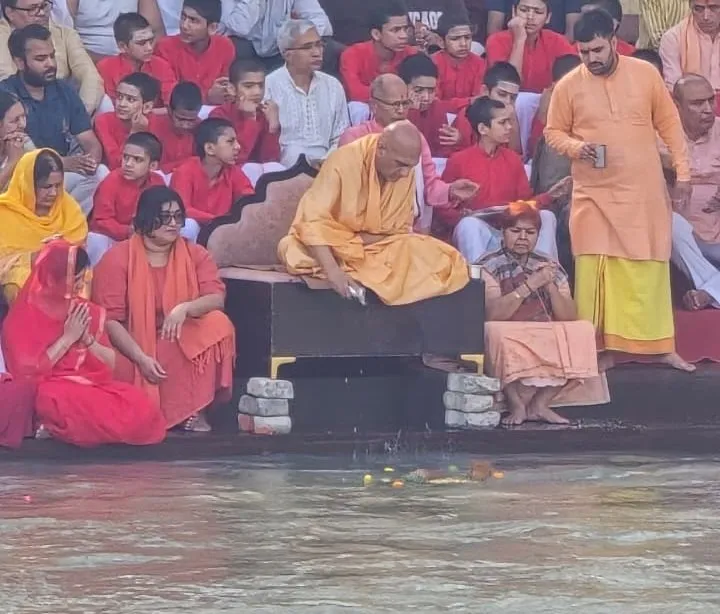
A defining feature of Swami Avdheshanand Giri’s work is his integration of environmental protection into traditional monastic duties. Rather than treating ecology as a purely secular concern, his teachings present environmental conservation as a direct expression of Vedantic philosophy and spiritual practice.
His water conservation efforts are summarized in his teaching: "Neer se hi Narayan hai" (Where there is Water, there is God). To put this philosophy into action, he launched the Shiv Ganga Abhiyan, a joint initiative of the Prabhu Premi Sangh and the Samagra Gram Vikas Parishad. This project focuses on the rural, tribal (Vanvasi) areas of the Jhabua district in Madhya Pradesh.
Through this initiative, more than eleven hundred villages have been adopted to implement sustainable rural development. The primary achievements of the Shiv Ganga Abhiyan include:
- Water Resource Creation: Excavating community water storage ponds, building check dams, and implementing rainwater harvesting systems to recharge groundwater tables.
- Cultivation of Barren Land: Developing and sharing techniques to restore degraded soil, enabling local tribal farmers to cultivate previously unproductive land.
- Safe Drinking Water Supply: Constructing delivery infrastructure to supply clean drinking water to remote tribal households.
- Socio-Spiritual Centers: Building small Shiva temples in every adopted village to serve as community gathering spaces that coordinate both local rituals and ecological maintenance projects.
To raise global awareness of these issues, Swami Avdheshanand Giri organized the International Water Parliament. This conference convened international environmental scientists, water resource researchers, policy-makers, and spiritual leaders to develop collaborative solutions for watershed degradation and water scarcity, demonstrating the capacity of monastic organizations to host serious scientific and policy dialogues.
Additionally, he is planning the establishment of the Swami Avdheshanand Foundation (SAF) in Bhopal, Madhya Pradesh. The foundation's goal is to construct a multi-dimensional institute on 150 acres of forest land, designed to train scholars in classical Indian culture, Vedic education, yoga, ayurveda, and environmental science to foster global harmony.
Global Interfaith Diplomacy and State-Level Representation
While maintaining his traditional duties as the head of Juna Akhara, Swami Avdheshanand Giri has also engaged in international interfaith diplomacy. As a board member of the World Council of Religious Leaders, he has represented Hindu monastic traditions at major global forums, presenting classical Vedic perspectives on contemporary global challenges like climate change, poverty, and inter-ethnic conflict.
In 2008, he participated in Israel’s Presidential Conference, "Facing Tomorrow," where his presentation of the Hindu worldview was praised by Israeli President Shimon Peres, who called him a "Man of Vision". In 2009, he was a keynote speaker at the Parliament of the World’s Religions in Melbourne, Australia, and participated in the Hindu-Jewish Summit in Jerusalem. In May 2019, he served as the chief speaker at the United Nations in New York for the "Responsible Leadership Summit," addressing over two hundred global delegates on ethical governance. His international work also includes participation in the Interfaith G8 Summit in Winnipeg, Canada (2011), the Samvad II and III global initiatives in Myanmar (2017) and Mongolia (2019), and a presentation on interfaith coexistence at the Muslim World League convention in Riyadh, Saudi Arabia (May 2022).
In India, his leadership is influential in both cultural preservation and public policy. As President of the Hindu Dharma Acharya Sabha, the apex body of Sanatan Dharma monastic orders, he regularly discusses national interest, spiritual education, and cultural preservation with senior government officials, including Union Home Minister Amit Shah. He also serves as an appointed member of the Sri Amarnath Shrine Board, helping formulate administrative policies for the annual Amarnath pilgrimage.
The funding and logistics of these widespread operations are supported by the Avdheshanandg Mission (AGM). AGM manages public donations for educational projects, rural healthcare camps, food distribution, and environmental initiatives under his direction. Contributions to AGM are eligible for tax exemption under Section 80G of the Income Tax Act, and the mission is authorized to accept international donations through secure official channels, ensuring transparent governance for his global activities.
Monastic Governance and the Future of Socially Engaged Asceticism
The comprehensive modernization of India's classical monastic structures is well documented when analyzing the distinct monastic orders of Sanatan Dharma. The comparative landscape reveals how Juna Akhara, through the leadership of Swami Avdheshanand Giri, has expanded its spiritual mandate into the modern era while maintaining the core disciplines of the Dashanami order.
|
Monastic Akhara Order |
Founding / Traditional Era |
Spiritual Head / Acharya |
Patron Deity |
Unique Structural and Monastic Focus |
|
Sri Panch Dashnam Juna Akhara |
1146 CE (Traditionally ancient Bairagi roots) |
Swami Avdheshanand Giri Maharaj |
Lord Dattatreya |
Largest and most diverse; contains over 200,000 members and 52 distinct lineages, including Tibetan Lama lines. |
|
Shri Panchayati Akhara Niranjani |
904 CE (Established 726 CE in Mandvi) |
Swami Kailashanand Giri Maharaj |
Kartikeya Swami |
Second largest order; highly focused on scriptural education, academic qualifications, and the preservation of Sanatan Dharma. |
|
Shri Panch Atal Akhara |
646 CE (One of the three oldest akharas) |
Swami Vishwatmanand Saraswati |
Lord Ganesha |
Known for extreme discipline; emphasizes both spiritual practices (mala) and defensive capability (bhaala). |
|
Shri Panchayati Akhara Mahanirvani |
749 CE |
Swami Vishokananda Maharaj |
Sage Kapilmuni |
Pioneered the organizational concept of Mandaleshwars; committed to eco-friendly living and theological investigation (mimansa). |
|
Shri Taponidhi Anand Akhara Panchayat |
1856 CE |
Swami Balkanand Giri |
Lord Surya |
Follows a decentralized protocol where junior ascetics speak freely; focused on Vedic education and nationalism. |
This comparative framework demonstrates the unique path Juna Akhara has taken under Swami Avdheshanand Giri’s stewardship. By systematically integrating traditional, non-dualist Advaita Vedanta with a highly decentralized socio-civic welfare infrastructure, he has created a scalable model for modern monastic organizations. Rather than retreating into isolation, his leadership demonstrates that modern sannyasa can actively engage with modern global challenges. This synthesis of classical monastic discipline with public service, ecological stewardship, and international interfaith diplomacy represents a significant evolution in contemporary Sanatan Dharma, establishing a clear template for the future of socially engaged spiritual leadership.
Keep Reading
View All Articles-
Aghoracharya Baba Keenaram
This article provides a comprehensive historical, philosophical, and anthropological analysis of Baba Keenaram hagiography, his seminal literary contributions, the sacred geography of his headquarters at the Krim Kund Sthal in Varanasi
-
स्वामी अवधेशानन्द गिरि : आचार्य महामंडलेश्वर श्री पंच दशनाम जूना अखाड़ा
संन्यासी सत्ता का आधुनिकीकरण: स्वामी अवधेशानन्द गिरि और श्री पंच दशनाम जूना अखाड़ा के विकास का एक विस्तृत विश्लेषण
-
द्वाराहाट: महावतार बाबाजी की साधना स्थली और क्रिया योग की शाश्वत परंपरा
इसकी भौगोलिक संरचना में ऐतिहासिक द्वाराहाट कस्बा, सिद्ध शक्तिपीठ दूनागिरी और अंतिम मोटर मार्ग बिंदु कुकुछीना शामिल हैं, जो महावतार बाबाजी की गुफा के मुख्य प्रवेश द्वार के रूप में कार्य करते हैं ।