





Himalayan & Mountain Shrines
Kalpa: The Sacred Land of Shiva
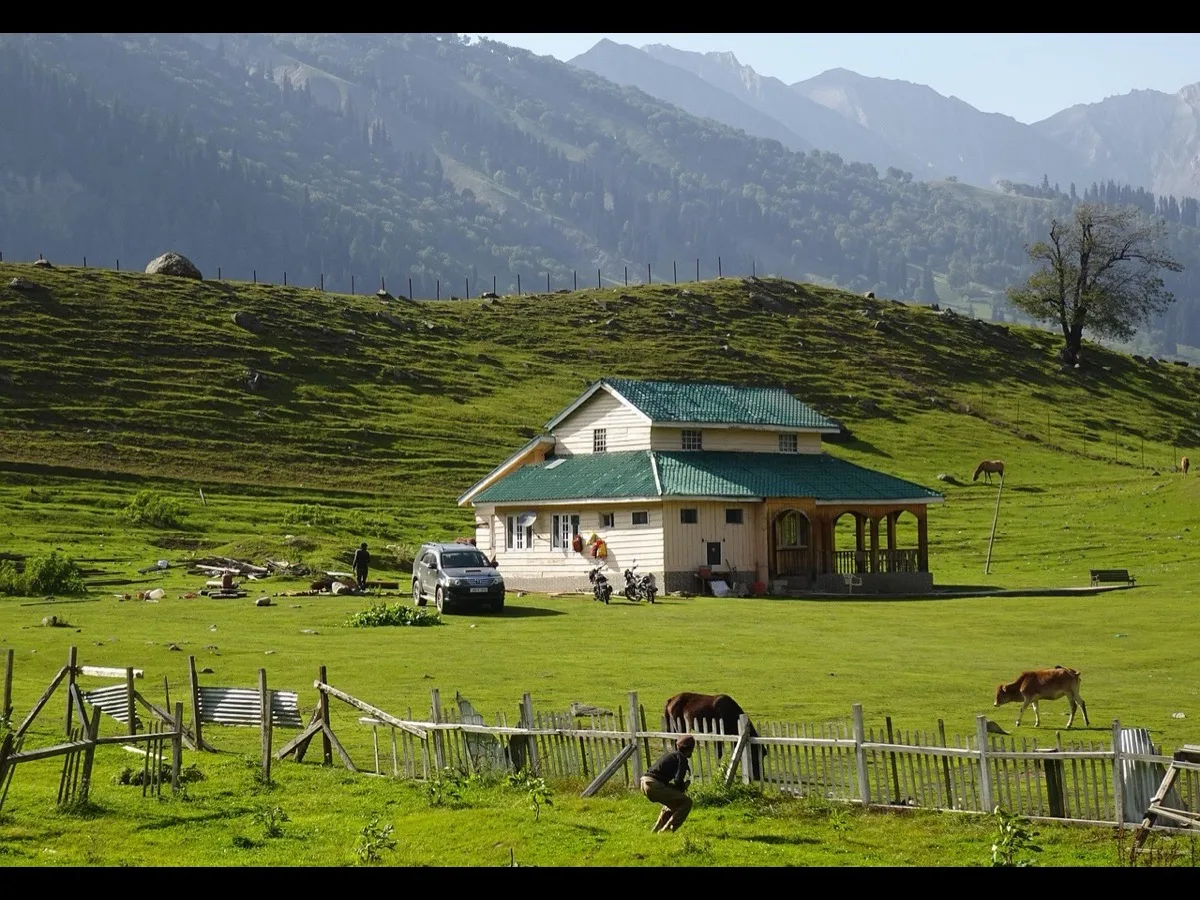
Geographical Context and Demographic Stratification of the Kinnaur Valley, The settlement of Kalpa, historically referred to as Chini, represents a critical high-altitude node in the Western Himalayas,
 By Spiritual Yatra
18 min read
By Spiritual Yatra
18 min read

The Kinnaur Valley (Kalpa)
Situated at an elevation of 2960 meters (9711 feet) within the Sutlej River valley of the Kinnaur district in Himachal Pradesh. Positioned along the ancestral Hindustan-Tibet trade route, Kalpa serves as both a geographical and cultural bridge between the Indian plains and the trans-Himalayan plateau. This positioning has historically facilitated not only the transit of luxury trade goods but also the deep integration of distinct metaphysical traditions.
The topography of the region features dramatic elevation gradients, where deep glaciated gorges contrast sharply with towering peaks, creating a mosaic of microclimates that support diverse ecological niches and agricultural patterns.
The demographic and cultural landscape of the Kinnaur district is stratified along a clear altitude gradient, which has shaped the physical typology, language, and religious identity of its inhabitants. The district is divided into three distinct territorial zones, illustrating a gradual transition from Indo-Aryan to Tibeto-Burman characteristics.
|
Cultural and Demographic Zone |
Geographical Boundaries |
Primary Physical Typology |
Dominant Religious Practices |
|
Lower Kinnaur |
Spans the corridor between Chora and the sub-regional node of Kalpa, including the Nichar and Sangla valleys. |
Primarily of the Mediterranean physical type, showing strong affinities with populations in the adjoining Shimla district. |
Predominantly Hindu, with localized early Buddhist influences embedded in daily worship. |
|
Middle Kinnaur |
Encompasses the territory between the Kalpa highlands and the village of Kanam, including the Moorang tehsil. |
Mixed physical strains, displaying an amalgamation of Mediterranean and Mongoloid features in varying degrees. |
Syncretic co-belief systems, with the population maintaining active faith in both Hindu and Buddhist pantheons. |
|
Upper Kinnaur |
Covers the northeastern reaches of the district from Pooh to the Hangrang valley, extending to the international border with Tibet. |
Predominantly Mongoloid, with the Hangrang valley population showing near-universal Mongoloid features. |
Universal adherence to Mahayana Buddhism, with deep-rooted Tibetan cultural influences. |
This spatial distribution positions Kalpa at the cultural intersection of Middle Kinnaur. This positioning has fostered a unique local identity characterized by the peaceful co-existence of differing worldviews.
The local population, the Kinnauras, maintains distinct socio-cultural systems, traditional wool-based material culture, and complex communal practices that reflect their close relationship with the surrounding alpine environment.
Traditional Attire and the Socio-Material Culture
The material culture of Kalpa is highly adapted to the harsh alpine climate, with the traditional wardrobe of the Kinnauras relying heavily on heavy woolen textiles woven within local households. The most recognizable element of this attire is the thepang, a round woolen cap worn universally by both men and women. The cap is typically light grey or white and features a distinctive velvet band on its outer fold, with deep green being the most favored color, though crimson, blue, and yellow are also common.
Men traditionally wear long woolen coats known as chhuba, which resemble an achkan, paired with a sleeveless woolen jacket and churidar pajamas. Women wrap themselves in a dohru, a heavy woolen shawl with an embroidered border displayed along its full length up to the heels, with darker shades of green, red, and blue being preferred.
This traditional dress is complemented by a choli, a full-sleeved blouse that often features decorative linings. While contemporary youth increasingly adopt globalized garments, the traditional woolen attire remains a key marker of regional identity during major festivals and marriages.
Historically, the indigenous footwear of the region was constructed from high-durability wool and goat hair, featuring soles made of treated goat hide. Although this traditional footwear has largely been replaced by modern manufactured shoes, the specialized techniques of processing wool and animal fibers continue to play a key role in the domestic economy of the Kinnauras.
Sacred Landscapes: Epic Cartography of Kinner Kailash
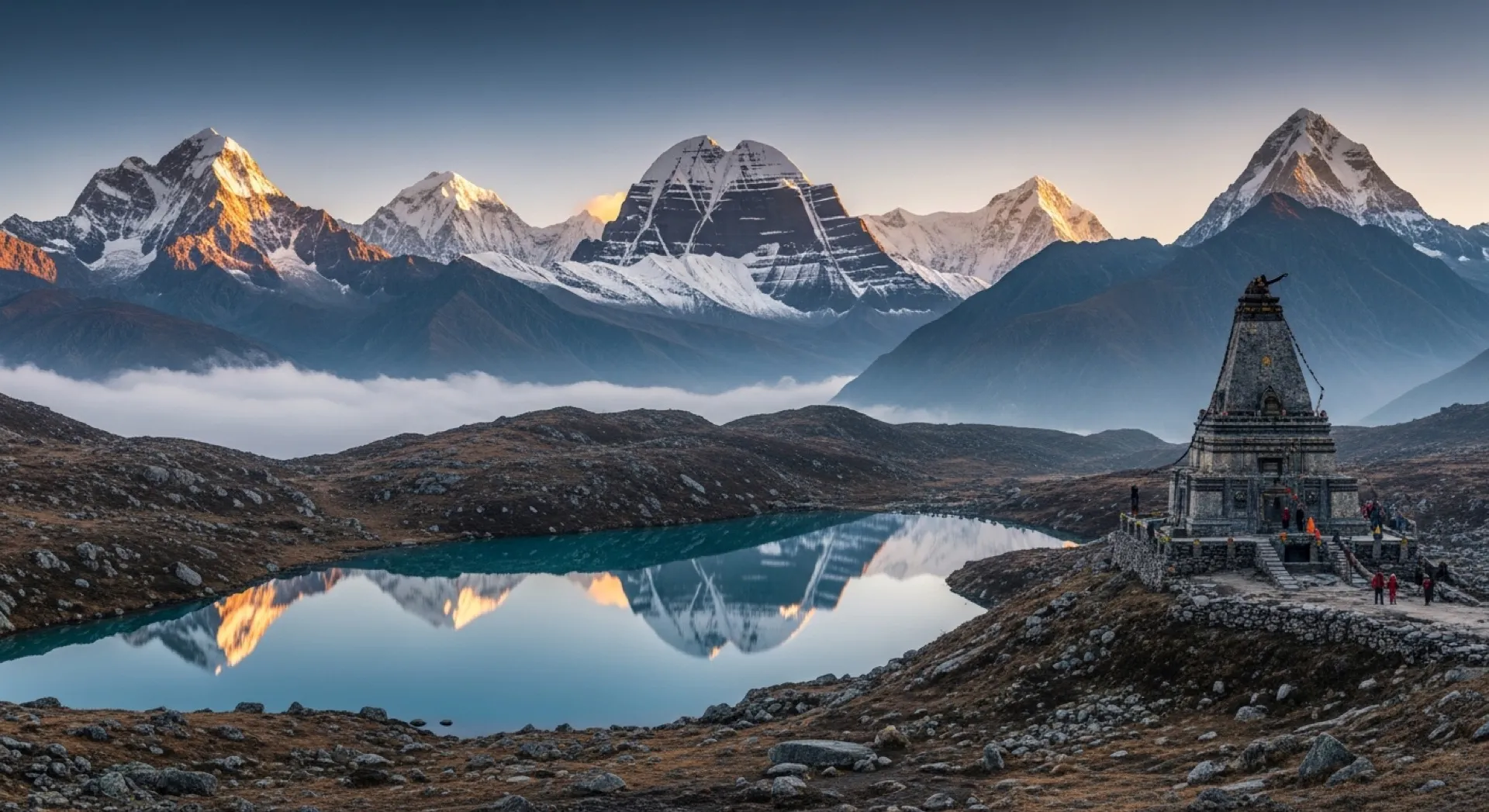
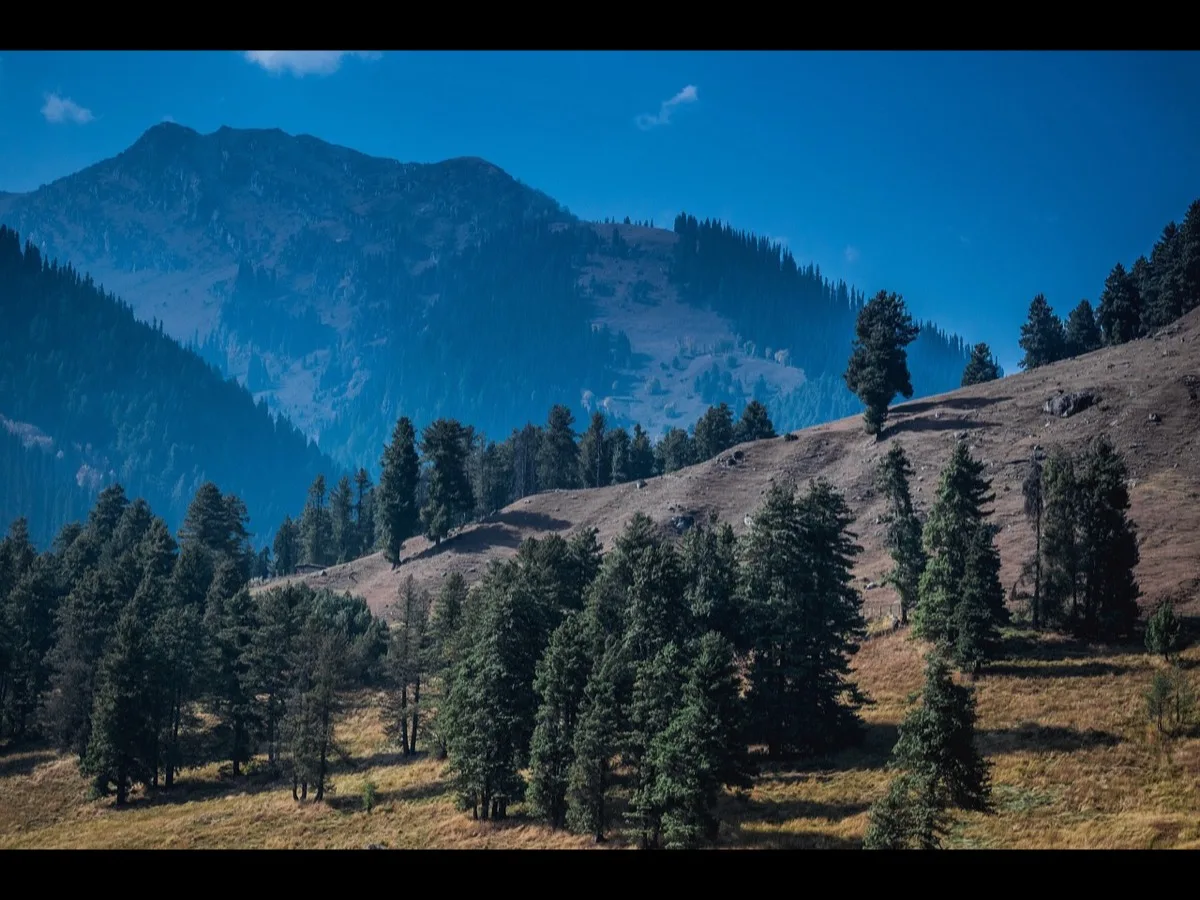
The sacred geography of Kalpa is defined by the Kinner Kailash mountain range, which rises directly across the valley to a high summit of 6050 meters (19849 Feet). In Hindu cosmology, this peak is revered as the divine winter home of Lord Shiva and his consort, Goddess Parvati. The mountain is also a focal point of Himalayan pilgrimage, representing the fourth most important peak among the sacred Panch Kailash.
|
Sacred Peak |
Geographic Location |
Elevation |
Primary Mythological Significance |
|
Mount Kailash |
Ngari Prefecture, Tibet Autonomous Region, China |
6638meters |
Celebrated as the spiritual center of the universe and the ultimate residence of Lord Shiva. |
|
Manimahesh Kailash |
Chamba District, Himachal Pradesh |
5653 meters |
Formed by Shiva post-marriage; circumambulation of the adjacent lake is believed to cleanse ancestral sins. |
|
Adi Kailash |
Pithoragarh District, Uttarakhand |
5945 meters |
Known as "Chota Kailash" for its physical resemblance to Mount Kailash; associated with the meditation of the Adi Yogi. |
|
Kinnaur Kailash |
Kinnaur District, Himachal Pradesh |
6050 meters |
Features a 79 foot color-changing monolithic rock column; recognized as the divine winter assembly grounds. |
|
Shrikhand Kailash |
Kullu District, Himachal Pradesh |
5227 meters |
Hosts a massive natural stone linga; accessed via a highly challenging pilgrimage route during the monsoon. |
The cultural transition of the Kinnaur Valley is highlighted by comparing Kalpa with adjacent high-altitude settlements. While Kalpa acts as a scenic, culturally syncretic base, other valley nodes present different facets of the region's geography and culture.
|
Destination |
Primary Attractions |
Elevation & Geography |
Ideal Travel Profile |
|
Kalpa |
Kinner Kailash views, centuries-old Kath-Kuni temples, Hu-Bu-Lan-Kar Monastery, extensive apple orchards. |
2960 meters; high-altitude terrace overlooking the deep Sutlej gorge. |
Perfect for slower travel, cultural studies, photography, and high-altitude workations. |
|
Sangla |
Baspa River corridor, green meadows, traditional wooden homes, Kamru Fort, trout fishing. |
2680 meters; broad, fertile river valley bordered by steep forested slopes. |
Suited for adventure seekers, families, fly-fishing enthusiasts, and leisure travelers. |
|
Chitkul |
Last inhabited village of India near the Indo-Tibetan border, pristine glacial streams, traditional architecture. |
3450 meters; alpine river valley characterized by extreme cold and rugged terrain. |
Ideal for offbeat backpackers, photographers, and high-altitude trekkers. |
The Legend of Bhasmasura and the Cosmic Assembly
The geographical features of Kinner Kailash are explained in local folklore through the legend of the demon Bhasmasura. Having engaged in long penance to please Lord Shiva, Bhasmasura secured a boon granting him the power to reduce any living being to ashes by placing his hand on their head.
- However, the demon harbored plans to target Shiva himself in order to possess Goddess Parvati. To prevent cosmic destruction, Lord Shiva fled, changing his residence multiple times before seeking refuge in the isolation of Kinnaur Kailash.
- On this peak, Shiva meditated to control the power of his third eye, eventually destroying the demon without causing planetary harm. The colorful hues observed during sunrises over the range are locally interpreted as positive energy radiating from Shiva’s third eye.
- This legend also attributes a regional assembly function to the mountain, asserting that Lord Shiva hosts an annual winter gathering of all Hindu deities on the summit.
- The Kinner tribe, who populated the region and gave their name to the mountain, are recognized in Puranic texts, the Ramayana, and Kalidasa's Meghdoot as a distinct clan of demi-gods. They
- are described as gifted musicians and dancers residing between the human and divine realms, a designation that highlights the historically perceived liminality of this remote mountain enclave.
Optical Refraction and Diurnal Color Shifts of the Shivlingam
A primary focus of devotion on the range is the natural monolithic rock formation standing at 4800 meters. This 79 foot vertical stone pillar, balanced precisely on a rock slab, resembles a trident and serves as a natural Shiva Lingam.
The column exhibits diurnal color shifts, changing from white before dawn, to yellow after sunrise, red/crimson at dusk, and deep black at night. This optical phenomenon, caused by the shifting angles of solar refraction on the mineral-rich stone, draws both pilgrims and scientific observers.
Adjacent to the peak at an altitude of 14900 feet lies Parvati Kund, a sacred high-altitude tarn believed to have been created by Goddess Parvati. The site, also referred to as "Aashiqi Park," is celebrated as the meeting place of the divine couple.
Devotees cast coins into its waters as a ritual offering to fulfill wishes. Pilgrims traditionally take a ritual bath in the cold waters of Parvati Kund before completing the final, challenging stretch of the pilgrimage.
High-Altitude Pilgrimage Paths and Buddhist Syncretism
The sacred geography of Kinner Kailash also features a distinct layer of Tibetan Buddhist mythology. For Buddhist pilgrims, the range is recognized as one of the 24 sacred sites where Padmasambhava (Guru Rinpoche), the founder of Tibetan Buddhism, engaged in deep meditation to attain enlightenment.
The physical proof of this spiritual history is localized in footprints attributed to Guru Rinpoche, preserved on a rock surface near the shores of Parvati Kund. This overlay of Hindu and Buddhist narratives on the same geographic features demonstrates the syncretism of the Kinnaur Valley, where the physical landscape is simultaneously interpreted through multiple sacred traditions.
Architectural analysis: Traditional Kath-Kuni Construction and Sacred Structures
The architecture of Kalpa is characterized by structural adaptations designed to withstand both seismic vulnerability and severe winters. The primary building methodology of the region is the ancient Kath-Kuni technique, which uses alternating, interlocking layers of dry stone and timber (predominantly deodar wood) constructed without the use of mortar.
During a seismic event, the lack of rigid mortar allows the building to flex and slide, effectively dissipating kinetic energy through the friction of the interlocking timber beams and dry stones, rather than fracturing. Additionally, the thick timber-and-stone walls provide thermal insulation, trapping interior heat during sub-zero winter temperatures.
The Syncretic Iconography of Narayan-Nagini and Hu-Bu-Lan-Kar
The Narayan-Nagini Temple Complex, situated in the center of Kalpa, serves as a prominent example of Kath-Kuni craftsmanship. The temple's design incorporates multi-tiered, pagoda-like roofs typical of Buddhist architecture, alongside intricate wooden carvings of dragons—symbols of wisdom and strength rooted in Tibetan Buddhist iconography.
The entrance to the temple is guarded by two wooden tiger sculptures, a traditional emblem of the goddess Chandika (a ferocious manifestation of Durga). This suggests that the temple was originally dedicated to her before transitioning into a shrine for Lord Narayan (Vishnu) and the serpent goddess Nagini Devi.
This co-worship of Narayan and Nagini represents a synthesis of classical Vaishnavism and indigenous animistic nature-worship, where Nagini Devi is revered as the guardian of local water sources, forests, and agricultural fertility.
Directly adjacent to the Narayan-Nagini Temple stands the Hu-Bu-Lan-Kar Monastery, a Buddhist gompa estimated to be nearly 1000 Years old, though the current structural envelope was built later. Marked by a massive white stupa and colorful prayer flags, its immediate physical proximity to the Hindu temple is a tangible symbol of the religious syncretism defining the region.
Rather than existing in isolated compartments, the two sacred spaces form a single spiritual sanctuary, where the local community participates in rituals that cross orthodox religious boundaries.
The Military and Sacral Architecture of Sapni Fort
The Sapni Fort, located 30 kilometers from Kalpa near Sapni village, is another significant architectural monument in the area. Constructed in the 17th century by the rulers of Kinnaur, and later expanded by Raja Padam Singh of Rampur, this colossal defensive structure was built by integrating two separate multi-storey towers.
The older tower stands seven storeys high, facing the valley from a strategic vantage point designed to monitor hostile movements along the Sutlej corridor. The fifth floor of the fort houses a temple dedicated to the goddess Kali, adorned with exceptional wood carvings on its window and door frames.
The fort's design, combining Himachali Kath-Kuni stonework with Tibetan-influenced wooden balconies and sloping roofs, showcases the regional blending of aesthetic and defensive forms.
Ritual Ecology: The Phulaich Festival and High-Altitude Botanical Conservation
The relationship between the Kinnaura people and their high-altitude environment is expressed in the Phulaich Festival (also termed Ookayand or Ukyam in local dialects, translating literally to the "festival of flowers"). Celebrated annually over a week starting on the 16th day of the Hindu month of Bhadrapada (corresponding to late August or September), the festival coincides with the peak blooming season of alpine wildflowers in the upper meadows of Kinnaur.
Historically, the festival's origin is tied to a legendary excursion by ten Rajput warriors who climbed into the high alpine meadows to collect wild blooms. Mesmerized by the fragrance and beauty of the flowers, their return to the village was celebrated with dances, music, and rituals, establishing an annual tradition of gratitude, ancestral remembrance, and ecological celebration.
Ritual Chronology of the Flower Festival
The festival functions through a highly structured sequence of rituals that link botanical collection with ancestral veneration and community solidarity :
● Day 1 (16th Bhadrapada): The village selects a dedicated group of 2 to 14 youth to trek into the alpine zones (3500 to 4500 meters) to collect specific species of sacred wildflowers.
● Days 2–3: The gatherers camp in the high meadows, selectively harvesting flowers while observing strict spiritual purity.
● Day 4: The return of the flower gatherers is greeted at the edge of the village with the sounding of drums and bugles. The community assembles at the ancestral Dhangaspa family house to pay homage to the historic pioneers of the region.
● Day 5: Intricate offerings of wild flowers, locally distilled wines, and rice are presented to deceased family members. Food is distributed to the marginalized, reinforcing communal ties.
● Day 20 (Extended Cycle): Gold and silver idols of local deities are decorated in traditional textiles and carried in public processions under deodar trees, accompanied by war dances performed with traditional weapons.
● Day 23: The deities are formally returned to their respective temples, concluding the festival.
Conservation and Sacred Geographies
From an ecological perspective, the Phulaich festival serves as an indigenous mechanism for botanical conservation and environmental monitoring. Ethnobotanical studies have documented at least 47 distinct plant species (consisting of 41 angiosperms and 6 gymnosperms) across 20 botanical families that are actively utilized during the rituals.
|
Botanical Taxon |
Local Name / Significance |
Ritual Application |
Ecological Function & Conservation Context |
|
Aconitum violaceum |
High-value alpine herb; believed to repel malevolent spiritual forces and protect the community. |
Included in the primary floral garlands offered to ancestral spirits at the Dhangaspa house. |
High conservation priority; native alpine species subject to over-harvesting; regulated collection helps sustain wild populations. |
|
Bistorta affinis |
Represents regional resilience and the transition of the seasonal alpine flora.25 |
Worn by youth and dancers during traditional war-reenactment dances under the deodar groves. |
Stabilizes fragile high-altitude soils; selectively harvested to prevent erosion in sensitive scree zones. |
|
Bergenia stracheyi |
Valued for its endurance in cold temperatures and long-standing medicinal properties. |
Offered alongside local wine and agricultural grains during the primary temple ceremonies. |
Key component of high-altitude rock crevices; indigenous harvesting protocols prevent habitat degradation. |
|
Saussurea species |
Revalued as sacred cosmic flora; associated directly with the blessings of Lord Shiva. |
Placed at the feet of the gold and silver deity idols during the Day 20 grand procession. |
Includes the threatened Brahma Lotus; strict harvesting taboos prevent decimation of this critical alpine taxon. |
The ritual restriction of harvesting duties to a small, designated group prevents the over-exploitation of fragile alpine flora. Furthermore, the spiritual taboos against damaging high-altitude herbs, such as the Brahma Lotus (highly favored by Lord Shiva), establish an informal ecological sanctuary in the fragile alpine zones.
By framing botanical collection as a highly regulated, sacred duty, the Phulaich festival helps maintain biodiversity in these sensitive high-altitude habitats.
Traditional Fare and Fermentation Practices
The food culture of Kalpa represents a systematic adaptation to high-altitude agriculture and the physiological demands of a cold, low-oxygen climate. The local diet is heavily reliant on cold-hardy crops like buckwheat, barley, wild apricots, and apples, alongside complex fermentation techniques that preserve organic nutrients through the winter months.
Traditional baked goods in Kinnaur rely on fermentation starters known locally as malera or treh. These natural starter cultures consist of complex consortia of wild yeasts and lactic acid bacteria.
This traditional biotechnology not only leavens the heavy grains but also pre-digests complex starches, increases the bioavailability of essential minerals, and synthesizes B-complex vitamins, which are vital for human health in high-altitude environments.
|
Food Element |
Primary Botanical Ingredients |
Cooking Technique |
Cultural / Ritual Occasion |
|
Sidu (Siddu) |
Fermented wheat flour, mashed potatoes, poppy seeds, and unshelled walnuts. |
Steam-cooked over wood fires; served hot with generous amounts of clarified butter (ghee). |
Daily high-calorie winter staple; offered during family gatherings and community meals. |
|
Bhatooru |
Fermented wheat or barley flour inoculated with malera. |
Oven-baked on flat stones; served alongside local lentil curries. |
Primary daily carbohydrate source across rural households in Middle and Upper Kinnaur. |
|
Marchu (Poltu) |
Fine wheat flour and regional salt. |
Deep-fried in mustard oil to produce crisp, long-lasting flatbreads. |
Crucial ceremonial food presented to relatives during Phagli, Halda, and weddings. |
|
Kinnaur Ka Dham |
Local buckwheat, barley, regional apples, and wild morel mushrooms (Guchchi). |
Prepared as a multi-course banquet by specialized male cooks called Botis. |
Served on large platters during temple festivals, community feasts, and local marriages. |
|
Chakki ka Saag |
Locally harvested leafy green vegetables and highland wild herbs. |
Slow-simmered in copper vessels with mountain mustard oil. |
Highly seasonal dish consumed primarily during the late spring and monsoon harvest periods. |
Most local restaurants in Kalpa are strictly vegetarian, reflecting the spiritual codes of the resident populations, though both vegetarian and non-vegetarian options are readily available in family homestays.
The culinary offerings are complemented by local beverages, such as Kinnaur Ka Chai, a warming tea prepared with mountain mint leaves and local multiflora honey , and Kinnaur Kulfi, a traditional frozen dessert flavored with cardamom, saffron, and wild rose petals.
Ethno-distillation and the Cultural Chemistry of Rak and Chhang
This expertise in fermentation also extends to the production of traditional alcoholic beverages, which are central to Kinnauri ritual life, festive gatherings, and winter survival. The Kinnauras produce several distilled and fermented beverages using wild fruits, grains, and tubers :
● Angoori (Kinnauri): A potent grape-based wine produced primarily in the Ribba region of Kinnaur, where green and crimson grapes are fermented and steam-distilled. Red grape fermentation yields a higher alcohol content (5.10% ABV) compared to green grapes (3.44% ABV). The beverage is consumed during major religious festivals and is also used as a traditional home remedy for colds and respiratory congestion.
● Chulli: A light, clear spirit distilled from dried wild apricots (chuli) and apples. It exhibits a translucent, vodka-like appearance and has a distinct fruity flavor profile.
● Chhang: A cloudy, lactic-acid-fermented beverage brewed from boiled barley seeds. Fermented in closed containers for up to a month, it is typically served hot by pouring warm water over the grains, filtering the liquid through bamboo straws, and adding a small dollop of butter.
These beverages are produced at the household level using traditional steam distillation apparatuses made of clay and copper. Because they are rich in calories and active yeast cultures, these drinks serve an essential biochemical role. They stimulate peripheral circulation, prevent hypothermia, and provide supplementary nutrients during the long winters when fresh agricultural produce is unavailable.
Chaka Meadows Trek
This intermediate day hike begins at a trailhead on the Kalpa-Roghi road near the Hotel Rakpa Regency (2960 meters). The 3 to 5 kilometers trail ascends steadily along a glacial stream, passing through terraced fields, stands of deodar, spruce, and blue pine, and open alpine meadows situated at 3800 meters.
The summit offers clear views of the Kinner Kailash range and Mount Raldang (5499 meters). During the summer months, local villagers reside in temporary stone shelters (Kandas) here to cultivate high-altitude crops before descending ahead of the autumn freeze.
Kinner Kailash Yatra Trek
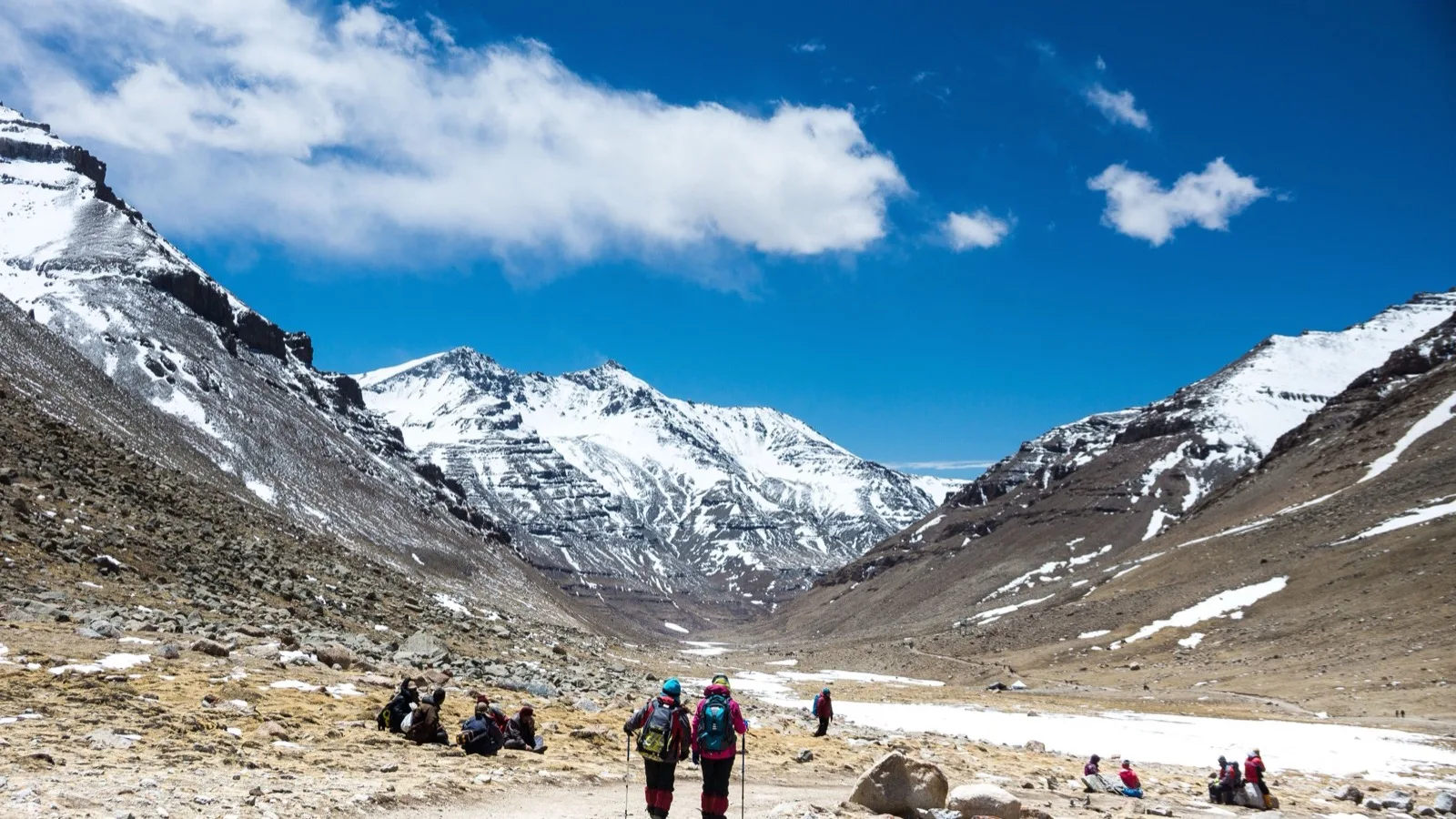
An advanced, multi-day pilgrimage open primarily during the auspicious Hindu month of Savan (July-August). The route begins with a ritual purification bath in the Sutlej River at Tangling village. Trekkers complete a vertical ascent of 10 kilometers to camp at Ashiqui Park (or Ganesh Bagh), followed by an arduous 10 kilometers trek to Parvati Kund.
The final 2 kilometers crossing of a glacier leads to the sacred 79 foot color-changing Shivling at 4800 meters. This trek requires physical fitness, high-altitude acclimatization, and a local guide.
Kinner Kailash Parikrama Trek
- A demanding 7 to 10 days circuit that circumambulates the entire Kinner Kailash massif. The route proceeds from Kalpa to the villages of Thangi and Lambar, then continues to the high-altitude settlement of Charang.
- Here, trekkers visit the ancient Rangrik Monastery and Charang Castle before tackling the crossing of the Charang La Pass at 5300 meters. This high-altitude pass requires specialized mountaineering gear and experience.
- Beyond these trekking routes, the immediate surroundings of Kalpa feature key viewpoints, such as Suicide Point, located 5 kilometers from the main market. It is known for its steep vertical cliffs that drop into the Sutlej gorge.
- Continuing 3 kilometers past this viewpoint is Roghi Village, a traditional settlement that preserves classic Kinnauri wooden architecture. The narrow, winding road between Kalpa and Roghi is carved directly into the cliff faces, highlighting the engineering challenges of the region.
Financial and Logistical Projections for Regional Travel
Executing a journey through the Kinnaur Valley requires structured financial planning and strict adherence to mountain transit regulations. The following matrix details the operational and financial requirements for travelers:
|
Expense Category |
Budget Option (Daily / Unit Cost) |
Mid-Range Option (Daily / Unit Cost) |
Key Operational Recommendations |
|
Accommodation |
INR 400 - 600 |
INR 1,00 – 1,500 |
Budget options include shared homestays; mid-range and luxury options offer private balconies facing the Kinner Kailash peak. |
|
Food & Dining |
INR 300-500 |
INR 600 - 800 |
Budget covers basic local diners; mid-range includes boutique cafes serving Siddu and momos. |
|
Local Transport |
INR 100 - 200 |
INR 500 - 800 |
Budget utilizes HRTC local buses; mid-range options rely on private cabs. |
|
Long-Distance Cab |
INR 3,500 Per Day |
INR 5,000 Per Day |
Multi-day bookings from Shimla or Chandigarh require robust vehicles with high ground clearance. |
|
Total 3-4 Day Trip |
INR 5,000 Total |
INR 12,000 Total |
Comprehensive projection per person, excluding long-distance transit. |
For travelers visiting Kalpa, managing these practical realities is essential for safety and comfort:
● Transportation Routes: National Highway 5 (NH5) via Shimla, Narkanda, Rampur, and Tapri; final 7 Kilometers ascent from Reckong Peo. High-ground-clearance vehicles are recommended.
● Public Transit: HRTC direct bus from Kashmiri Gate (Delhi) to Reckong Peo, with local shuttle buses to Kalpa. The local shuttle fare is approximately INR 25 for the 20 minute transit.
● Financial Services: ATMs are limited in Kalpa. Travelers should withdraw cash at the regional headquarters in Reckong Peo (7 Kilometers below).
● Emergency Medical: Basic local dispensaries in Kalpa village. Major medical emergencies require transit to the hospital in Reckong Peo.
● Permits: No special permits for Indian nationals. Foreign nationals must secure an Inner Line Permit (ILP) depending on the specific transit route.
● Environmental Codes: To preserve the fragile ecology, travelers should strictly avoid single-use plastics and carry reusable water bottles to manage altitude dehydration.
Kalpa stands as a remarkable testament to the integration of sacred landscape, resilient architecture, and community-led conservation. Positioned at the cultural intersection of Hindu and Buddhist worlds, it has preserved a unique syncretism where diverse traditions enrich one another.
From the seismic durability of its Kath-Kuni temples to the environmental protection of the Phulaich festival, the customs of the Kinnauras are deeply intertwined with their high-altitude environment. For those who visit, Kalpa is not merely a mountain destination, but a living sanctuary of Himalayan heritage, resilience, and devotion.
Keep Reading
View All Articles-
Legend & Pilgrimage of the Amarnath Cave
Tucked away at the far end of the Lidder valley in the Greater Himalayas, the Amarnath Cave
-
No Fear Is Visible to Faith at Yamunotri
Despite the long, exhausting journey, the fear of being struck by wooden sticks protruding from palakis (palanquins)
-
Shrikhand Mahadev Kailash Yatra
हिमाचल प्रदेश के कुल्लू जिले की गगनचुंबी हिमालयी श्रृंखलाओं में स्थित श्रीखंड महादेव कैलाश यात्रा न केवल भारत के सबसे कठिन पर्वतारोहण मार्गों में से एक है, बल्कि यह सनातन धर्म की गहरी आध्यात्मिक चेतना का जीवंत प्रतीक भी है ।