
Festival & Utsav
Ambubachi Mela: Kamakhya Temple Complex Assam
Overlooking the Brahmaputra River, this ancient temple is recognized within the Shakta tradition as the oldest and most potent of the fifty-one Shakti Peethas.
 By Prerak "प्रेरक"
17 min read
By Prerak "प्रेरक"
17 min read

Sacred Geography and Spatial Mandalas of Nilachal Hill
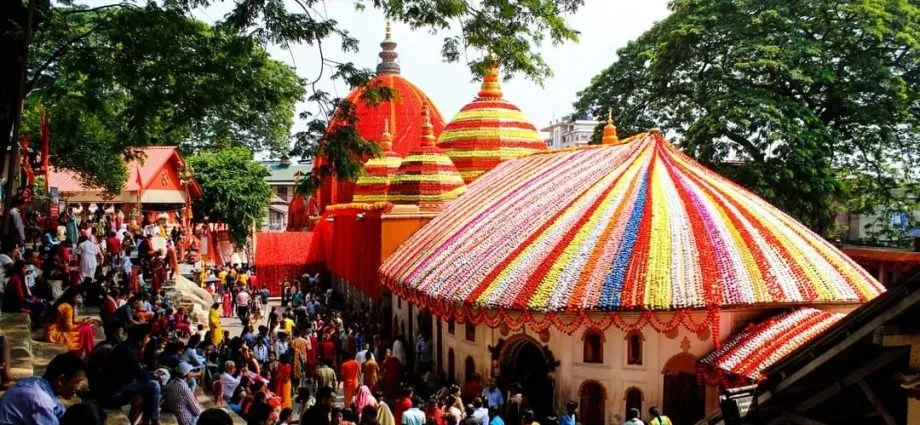
The Kamakhya Devalaya, situated atop the Nilachal Hill in Guwahati, Assam, represents one of the most significant spiritual and geographical nodes of South Asian sacred topography. Overlooking the Brahmaputra River, this ancient temple is recognized within the Shakta tradition as the oldest and most potent of the fifty-one Shakti Peethas. Unlike classical Hindu temples that direct devotion toward anthropomorphic icons, the inner sanctum (garbhagriha) of the Kamakhya Temple contains no physical idol. Instead, worship is centered upon a natural stone fissure resembling a female vulva (yoni-mudra), which is kept permanently moist by an underground natural spring. This geologic arrangement serves as the core of a complex liturgical framework that honors the feminine principle of creation, fertility, and cosmic energy.
The administration of this sacred site is overseen by a structured priestly hierarchy. The executive committee of the Maa Kamakhya Devalaya is led by Sri Kabindra Prasad Sarma (the Bor-Doloi, or chief priest), Sri Himadri Sarma (the Saru-Doloi, or junior head priest), and Sri Jnan Nath Sarma, also known as Gyan, who serves as the Secretary. This administrative body, working in coordination with the Government of Assam and the Department of Tourism, manages both the daily liturgical operations and the complex municipal logistics of the annual Ambubachi Mela.
The spatial organization of Nilachal Hill is designed as a sacred mandala. The central Kamakhya temple is surrounded by individual sanctuaries dedicated to the Ten Mahavidyas, the personified aspects of Tantric wisdom. Rather than functioning merely as auxiliary shrines, these temples form a cohesive metaphysical landscape that draws distinct lineages of Tantric practitioners. To illustrate this spatial and iconographic arrangement, the prominent Mahavidya temples on Nilachal Hill are detailed in the following table:
Comparative Profile of the Prominent Mahavidya Temples on Nilachal Hill
|
Mahavidya Deity |
Iconographic Form |
Liturgical Domain & Planet Governed |
Geographical Location on Nilachal Hill |
|
Mahakali |
Dark-skinned, disheveled hair, adorned with a garland of severed human heads. Holds a severed head, a large machete (kharga), and displays the barmudra gesture under a crescent moon. |
Served as the primary deity for intense sadhana. Governs the planet Saturn (Shani) and is traditionally worshipped on Saturdays. |
Positioned to the east of the central Kamakhya temple. |
|
Tara (Nil Saraswati) |
Fair-skinned, three-eyed, and four-armed, holding a kharga, a ceremonial knife (kartarika), a severed head, and a water lily. Clad in tiger skin and standing upon a funeral pyre. |
Governs the planet Jupiter (Guru Brihaspati). Grants the power of speech (Bak-shakti) and offers protection from deep-seated fear as Ugratara. |
Located between the Mahakali temple and the central Kamakhya temple. |
|
Bhairavi |
Radiant skin reflecting the mid-morning sun, clad in red garments. Holds a machete (borda), a book (pushtak), prayer beads (japmala), and displays the protective abhaymudra. |
Governs transformative fire and sacred speech. Worshipped in thirteen distinct forms, including Tripura Bhairavi and the five-faced Annapurna Bhairavi. |
Integrated within the central sacred perimeter of Nilachal Hill. |
Mythological Foundations and Historical Reconstructions
The Cosmological Fall of Sati and the Kamadeva Restoration
The primary mythic framework of the Kamakhya Temple is rooted in the Puranic cycle of Goddess Sati and Lord Shiva. According to the Kalika Purana, an essential ninth-century Shakta text, Sati immolated herself in response to the public humiliation of her husband, Shiva, by her father, King Daksha, during a grand sacrificial fire (yagna). Grieved and enraged by her death, Shiva carried Sati's corpse on his shoulders and began the cosmic dance of destruction (Tandava), threatening to dissolve the universe. To restore cosmic order, Lord Vishnu intervened by utilizing his celestial disc (Sudarshana Chakra) to sever Sati’s body into fifty-one pieces. These fragments fell across the Indian subcontinent, establishing the sacred map of the Shakti Peethas. The womb and genitals (yoni) of the goddess fell on the Nilachal Hill, consecrating the site as the ultimate seat of creative power and feminine energy.
Following this cosmological scattering, the site remained obscured from mortal knowledge until Kamadeva, the Hindu God of Love, sought out the yoni-mudra. Kamadeva had been reduced to ashes by the fire of Lord Shiva’s third eye after attempting to arouse desire within the meditating ascetic. Though Shiva later revived Kamadeva at the pleading of his consort Rati, he was restored without his original physical form and beauty (rupa). Shiva instructed Kamadeva to locate the sacred yoni-mudra on Nilachal Hill and perform rigorous penance to the Goddess. Upon successful completion of his meditation, Kamadeva received the blessings of the Devi, fully regained his beauty, and in gratitude, constructed a magnificent temple over the sacred site with the assistance of the celestial architect Vishwakarma. This mythological restoration gave rise to the historical and regional designations of the territory as Kamarupa (the land of the form of love/desire) and the deity as Kamakhya (the one worshipped by Kama).
The Pride of Brahma and the Creation of Demon Kesi
The temple’s oral and written records preserve a distinct legend involving Lord Brahma, the creator deity, whose supreme creativity led to a state of spiritual arrogance. To dismantle this pride, the primal goddess Sanatani Kali manifested a formidable demon named Kesi directly from Brahma's own body. Immediately upon his creation, the demon turned on Brahma, attempting to devour him. Brahma fled alongside Vishnu, eventually recognizing his spiritual error and pleading with the Goddess for protection. The Goddess intervened, slew the demon Kesi, and instructed Brahma to perform penance on Nilachal Hill, thereby establishing the site as a space of purification for even the highest cosmic entities. This legend reinforces the theological supremacy of the Shakta goddess over the traditional masculine trinity of the Hindu pantheon.
The Dynasty of Naraka and the Curse of Vashistha
The mythological history of the site is further elaborated through the lineage of Narakasura, a legendary monarch identified as the son of Lord Vishnu and the earth goddess Dharitri. Raised in Mithila, Naraka established his sovereignty over the ancient kingdom of Pragjyotisha after defeating the indigenous Kiratas led by their king, Ghatak, who were the historical guardians and early worshippers of Goddess Kamakhya. While Naraka initially maintained deep devotion to the Goddess, his later association with Banasura, the king of Sonitpur, corrupted his reign, leading to acts of tyranny and arrogance.
This corruption culminated in two significant events. First, Naraka prevented the revered Vedic sage Vashistha from ascending Nilachal Hill to perform darshan (sacred viewing) of the Goddess, prompting Vashistha to utter a dual curse condemning both Narakasura to death and the temple complex to a period of decline and abandonment. Second, driven by desire, Naraka sought to marry Goddess Kamakhya. The deity playfully agreed on the condition that he construct a masonry road, a stone staircase, and a temple tank from the foot of Nilachal Hill to the summit within a single night before the first cock crowed to herald the dawn. Naraka accepted the challenge and nearly completed the structural task using his immense strength. Fearing his success, the Goddess strangled a cock and forced it to crow prematurely, duping Naraka into believing he had failed. Enraged, Naraka abandoned the construction halfway. The incomplete stone pathway, known as the Mekhelauja Path, and the locality of the event, known as Kukurakata (where the cock was slain), remain physical and linguistic markers of this myth on Nilachal Hill. Naraka's tyrannical reign was ultimately terminated when Lord Vishnu intervened and slew him.
Imperial Patronage and Architectural Rebuilding
The historical reality of the Kamakhya Temple is characterized by successive cycles of destruction and reconstruction, transitioning from ancient indigenous worship sites to imperial state sanctuaries. While early structural elements are dated to the seventh century CE, a cohesive stone temple complex was firmly established between the eighth and tenth centuries CE under regional dynasties. Local folklore associates the revival of the temple with the founder of the Koch Dynasty, King Viswa Singha. During a military engagement with the Ahoms, Viswa Singha and his brother, Siva Singha, lost their way and ascended Nilachal Hill, where they encountered an old woman who revealed the hidden, ruined pithasthan of Goddess Kamakhya. Viswa Singha prayed for victory and promised to construct a golden temple on the site upon his success. Having achieved his objectives, he attempted to construct a brick structure, but the walls repeatedly collapsed. Devotional accounts state that the deity appeared in a dream, advising him that a pure gold temple was structurally unfeasible and instructing him to mix a symbolic quantity of gold with the mortar of the brickwork.
This early Koch structure was subsequently demolished, with historical sources attributing the destruction either to the military incursions of the general Kalapahar or to a severe natural calamity. The temple was rebuilt over the ancient stone ruins in the mid-sixteenth century (completed circa 1565 CE) by King Viswa Singha’s successor, King Naranarayana, and his brother, the military commander Chilarai. This reconstruction is historically justified by local legends, including the tale of the chief priest Kendukalai, who reportedly witnessed the Goddess dancing within the closed doors of the garbhagriha during evening prayers (Aarati). King Naranarayana, desiring to see the divine dance, pressured the priest into carving a viewing hole in the temple wall. Upon discovering the intrusion, the Goddess punished both the priest and the king, bringing an end to the direct sensory manifestation of the deity and cementing the authority of the Koch kings over the temple's structural upkeep. The architecture resulting from this reconstruction is known as the "Nilachal type," featuring a beehive-shaped dome (shikhara) built over a polygonal stone base adorned with highly detailed relief carvings of deities and spiritual figures.
The Rituality of the Ambubachi Mela: Pravritti and Nibritti
The liturgical calendar of the Kamakhya Devalaya peaks during the Ambubachi Mela, a celebration synchronized with the summer solstice and the monsoon season. Celebrated during the Assamese month of Ahaar (mid-June), this gathering marks the annual menstruation cycle of Goddess Kamakhya. The festival is structured around two distinct liturgical phases: Pravritti (commencement) and Nibritti (completion and purification).
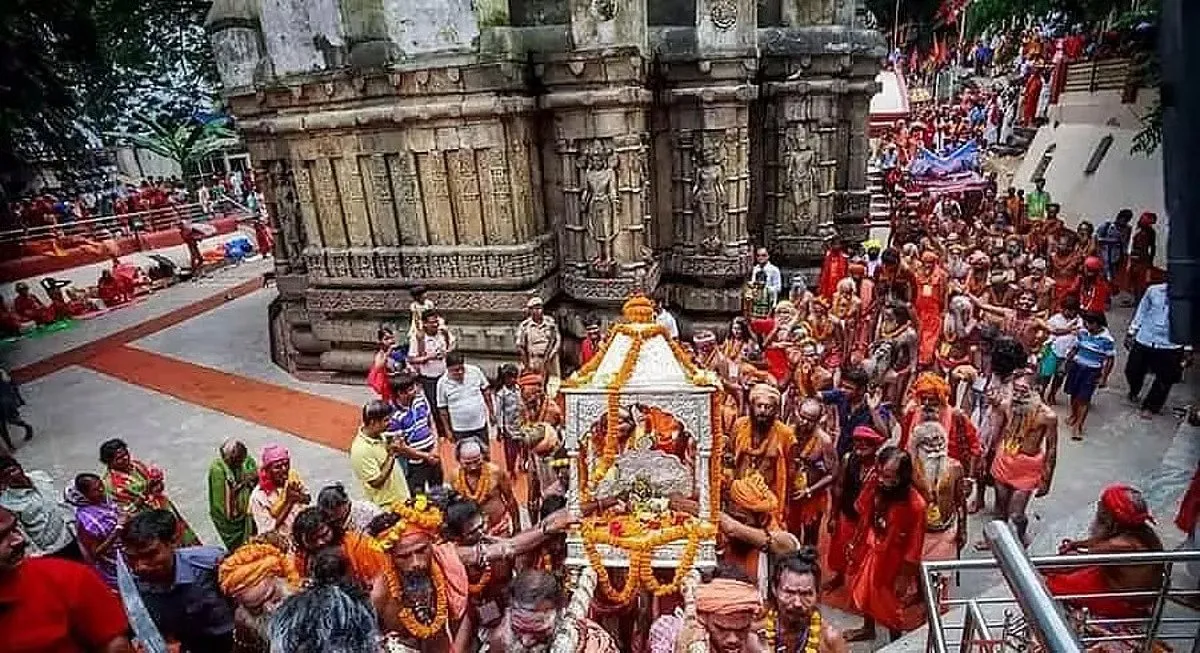
The transition to Pravritti begins when the sun transits to the zodiac of Gemini (Mithuna). At this calculated astrological hour, the temple priests perform the final daily rituals, wash the garbhagriha, and seal the heavy main doors. A white cloth is placed over the natural stone yoni fissure. For three days, the temple remains closed, and the Goddess is believed to be in a state of menstrual rest. No public viewing (darshan) is permitted, and the spiritual energy of the temple is turned inward, symbolizing a period of cosmic retreat and regeneration.
During this seclusion, traditional families in Assam observe domestic rituals known as Xathlagil. The household altar (puja ghar) is covered with a clean cloth to grant the domestic deities privacy. Devotees renounce cooked meals, subsisting entirely on raw fruits and water, and avoid touching the ground directly, as Mother Earth is also believed to be menstruating. On the fourth day, corresponding with the Nibritti phase, the home undergoes a thorough cleaning process. All bed linens, curtains, and utensils are washed to restore ritual purity. This demanding domestic labor historically falls primarily upon women, particularly widows, highlighting a distinct gendered division of ritual responsibility within traditional Assamese society.
At the hour of Nibritti, the temple doors are opened following purification rituals performed by the priests. The natural spring water flowing over the yoni is collected as Angodak (body water), and the white cloth placed over the stone, now turned red, is cut into small pieces and distributed as Angabastra (body cloth). These sacred tokens are highly difficult to obtain without direct connections to the temple priests (pandas), establishing a subtle hierarchy of access within the devotional economy. Visitors during this phase will also notice the large population of pigeons on the temple roof, which appear reddish in color due to being covered in sindoor (vermilion) during the intensive reopening rituals.
Demystifying Miracles, Rumors, and Misconceptions
The fame of the Kamakhya Temple and the Ambubachi Mela has led to a variety of popular rumors and misconceptions. Chief among these is the belief that the Brahmaputra River physically turns "blood-red" for the three days of the festival. Himadri Sarma, the junior head priest, has clarified that while the Goddess's cycle is deeply revered as a symbolic truth representing fertility and creation, the idea that the entire Brahmaputra changes color is fictional, passed down through oral tradition rather than grounded in geographical fact.
The reddish discoloration that does occur in the local springs and rock fissures of Nilachal Hill during the monsoon can be explained by several natural and geophysical factors:
- Ferric Oxide (): Nilachal Hill is geographically composed of iron-rich rock formations. During the heavy monsoon rains in June, the water table rises, forcing underground springs to flow through these iron-rich fissures. The water leaches iron ore and rust (ferric oxide, ), resulting in a distinct reddish-brown discoloration of the water emerging from the rock cracks.
- Cinnabar Deposits (): The bedrock of the hill contains natural deposits of cinnabar, a bright scarlet mercury sulfide mineral () known locally as Kamiya Sindoor. The physical erosion of these deposits by the monsoon runoff contributes a vibrant crimson pigment to the local spring waters.
- Red Algae Growth: The seasonal increase in temperature and the sudden influx of organic-rich rainwater during the mid-June monsoon create ideal conditions for the rapid multiplication of specific freshwater red algae in the shallow pools surrounding the temple hill, giving the standing water a reddish tint.
- Ritual Contributions: The active contribution of the temple priests and thousands of devotees plays a significant role in this coloring. Large quantities of red vermilion (sindoor), red food coloring, and red cloth offerings are ritualistically dissolved into the sacred spring water flowing over the yoni rock, intensifying the red coloration as the water drains down the hillside.
In addition to the "red river" myth, temple authorities have actively addressed other persistent rumors. It is often claimed that the temple doors miraculously shut and open on their own during the Pravritti and Nibritti transitions. Priests clarify that there is no supernatural force involved; the heavy doors are ceremonially closed, locked, and opened by the temple priests in accordance with age-old liturgical protocols.
Similarly, the myth of ongoing human sacrifice at Kamakhya continues to linger in popular imagination, fueled by the temple's association with esoteric Tantric rituals. Scholarly research and temple administrators confirm that there is absolutely no historical or contemporary evidence of human sacrifice at the temple. Animal sacrifices (typically goats or buffaloes) are performed within a strictly regulated ritual framework, but the association with human sacrifice is a modern sensationalism.
Priests also note that some individuals exploit the festival's esoteric reputation to engage in fraudulent or impure practices, offering fake spiritual remedies or performing unsanctioned rituals to exploit vulnerable pilgrims, which can malign the temple's image.
Socio-Political and Economic Dynamics of the Mela
The Ambubachi Mela functions as a major socio-economic event in Northeast India, attracting over five hundred thousand pilgrims annually, primarily from West Bengal, Bihar, Jharkhand, and Uttar Pradesh. This massive gathering, often referred to as the "Kumbh of the East," provides a significant boost to the regional economy of Assam. It generates seasonal livelihoods for local artisans, transport operators, hospitality providers, and street vendors selling religious items like flowers, incense, and vermilion. The Assam Tourism Development Corporation (ATDC) collaborates with the temple administration and local voluntary organizations to erect massive temporary shelters, run 24-hour community kitchens (langars), and manage medical camps.
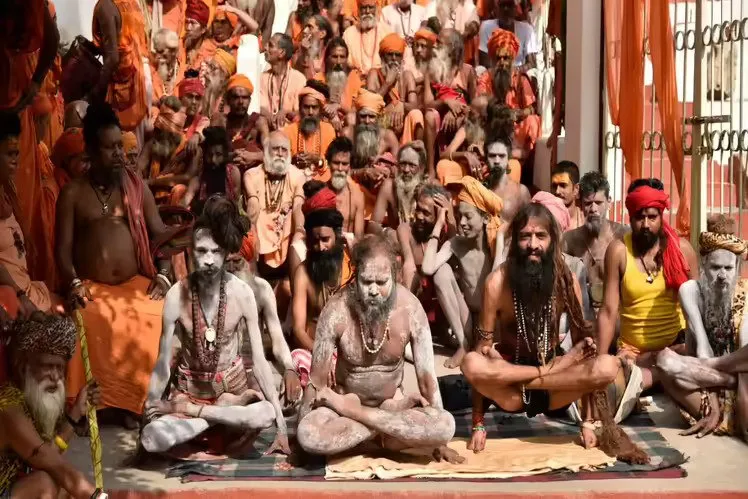
The festival is also unique in its gathering of diverse ascetic communities. Sanyasins, black-clad Aghoris, Naga sadhus, and Baul singers from West Bengal converge on Nilachal Hill, establishing temporary camps (akharas). Many of these ascetics live in complete isolation for the rest of the year, making their only public appearances during the four days of the Mela. They perform nightly circumambulations (parikrama) of the temple, offering blessings and teachings to householder devotees.
From a critical sociological perspective, the Ambubachi Mela presents a sharp contrast between progressive theological ideals and contemporary social realities. At a theoretical level, the festival directly challenges the widespread social stigma surrounding menstruation in South Asia. By celebrating the menstrual cycle of the Goddess as a source of cosmic power and fertility, the tradition offers an inclusive, body-affirming model of the divine feminine. This theological openness translates into a unique space of access, where traditional caste barriers are lowered, and marginalized groups, including Dalits, Adivasis, and transgender hijra sannyasis, occupy central roles in the celebration.
However, critics point out that this abstract celebration of divine biological processes does not always translate into social change for local women, who continue to face rigid taboos, isolation, and practical exclusion during their own menstrual cycles. Additionally, the rapid growth of religious tourism has commercialized the sacred economy of Nilachal Hill. While ordinary, low-income pilgrims wait in long queues for days to catch a glimpse of the deity, wealthy patrons and political elites frequently bypass these lines through monetary donations or social influence, highlighting a visible class divide within the devotional space.
Regional Comparisons of Divine Biology
The theological celebration of the earth's biological cycles is not unique to Kamakhya; it belongs to a broader network of South Asian agricultural and theological traditions. This is most clearly seen in the comparison between the Ambubachi Mela and the Raja Parba festival of Odisha.
Raja Parba, also known as Mithuna Sankranti, is a four-day festival celebrated in Odisha that honors Bhudevi (the Earth Goddess and consort of Lord Vishnu) during her annual menstrual cycle, marking the arrival of the monsoon and the agricultural reset. The festival is divided into specific ritual days: the day before the festival is Sajabaja (preparatory day), followed by Pahili Raja (first day), Mithuna Sankranti (second day), and Bhuin Dahana or Basi Raja (third day). The festival culminates on the fourth day with Basumati Snana, where women ritualistically bathe the grinding stone (pidhi/pidha) in their kitchens—symbolizing Bhudevi—with cowdung, turmeric paste, vermilion, and flowers.
During these three days, all agricultural work is suspended to allow the Earth to rest. Young girls and women are exempted from domestic chores, dress in new clothes, apply red dye (alata) to their feet, and play on flower-decorated swings (doli). Traditional delicacies like Poda Pitha (a baked rice-and-coconut cake) and Chitau Pitha are prepared and shared. While the Ambubachi Mela focuses on the esoteric and the divine within a localized temple environment, Raja Parba is a decentralized domestic celebration of womanhood, agricultural fertility, and maternal rest.
A similar tradition is observed at the Chengannur Bhagavati Temple in Kerala. In this temple dedicated to Goddess Parvati, the sanctum is closed for three days upon the detection of a symbolic red stain on the vestments of the deity, a ritual process known as urrucal. The Goddess is kept in seclusion before being given a ceremonial bath (Arat) in the river on the fourth day, restoring her to the main altar. These regional variations demonstrate a shared cultural framework that recognizes and honors the biological cycles of the divine feminine, contrasting with the more restrictive protocols found in other classical temples, such as the Sabarimala Temple in Kerala, where women of menstrual age have historically faced structural exclusion from the sacred precinct.
Spatial and Administrative Logistics of Nilachal Hill
Managing the Ambubachi Mela requires a high level of coordination between the temple's administrative committee, the municipal authorities of Guwahati, and the state government. To assist travelers, tour operators, and municipal administrators, the geographical access points, transport networks, and regional attractions are detailed in the tables below:
Comparative Geography and Travel Logistics of the Kamakhya Pilgrimage
|
Transport Node / Destination |
Distance to Temple |
Infrastructure & Facilities |
Operational Strategy & Helplines |
|
Lokpriya Gopinath Bordoloi International Airport (GAU) |
~20 km |
Serves domestic and international flights; primary entry point for long-distance travelers. |
Pre-paid taxi counters are available inside the arrival terminal. Travelers should utilize the national tourist helpline (1363) for real-time assistance. |
|
Kamakhya Junction Railway Station |
~6 km |
Located near the base of Nilachal Hill; primary transit node for regional pilgrims. |
Special festival trains and extra coaches are deployed by Indian Railways during the Mela. First-aid and tourist assistance booths are positioned at the main exit. |
|
Guwahati Railway Station |
~8–9 km |
High-capacity central railway terminal. |
Connecting city buses and government shuttle networks run continuously between the station and the foothills. |
|
Nilachal Hill Pathway |
~3 km ascent |
Winding masonry road and traditional stone staircase ascending 800 feet. |
Private vehicle traffic is completely restricted during peak festival days. High-frequency, state-run electric shuttle fleets operate along the route. |
Surrounding Historical and Ecological Sites of the Kamarupa Region
|
Attraction Name |
Distance/Location |
Regional and Cultural Significance |
Key Highlights |
|
Umananda Temple |
Brahmaputra River, Guwahati |
Located on the world's smallest inhabited river island. |
Dedicated to Lord Shiva; accessible via ferry rides from the Guwahati banks, offering panoramic river views. |
|
Navagraha Temple |
Chitrachal Hill, Guwahati |
Dedicated to the nine celestial planets of Hindu astrology. |
Historically served as a center for astronomical research and astrological calculations in ancient Kamarupa. |
|
Pobitora Wildlife Sanctuary |
Near Guwahati |
High-density habitat for the endangered Indian one-horned rhinoceros. |
Offers jeep and elephant safaris through grassland and wetland ecosystems. |
|
Sualkuchi Village |
Near Guwahati |
Recognized as the primary silk-weaving hub of Assam. |
Famous for the production of indigenous Muga, Pat, and Eri silks, utilizing traditional handloom techniques. |
Keep Reading
View All Articles-
Playing Holi with Butter at Dayara Bugyal Holi in the monsoon
Playing Holi with Butter at Dayara Bugyal Holi in the monsoon, and with only butter and curd milk as the colours! Well, there is no need for us to be surprised.
-
Diwali Significance, History & 5-Day Festival Guide
Explore the spiritual meaning, myths, and history of Diwali. Discover the significance of the 5-day celebration of the festival of lights
-
Dussehra Festival in India : Celebrations in Almora, Kullu, and Mysore
Dussehra, also known as Vijayadashami, is one of India’s most celebrated festivals, symbolizing the victory of good over evil. This article explains the meaning of Dussehra, its connection with Navratri, Ramayana, and the defeat of Mahishasura, along with traditional customs followed across Indian states.