
Festival & Utsav
The Saga Dawa Festival : Holy Period of Himalaya
The cultural and spiritual landscape of the Himalayan region is profoundly shaped by Saga Dawa, a holy period observed across Tibet, Ladakh, Sikkim, Nepal, and the wider Himalayan world.
 By Spiritual Yatra
12 min read
By Spiritual Yatra
12 min read

The Saga Dawa Festival: A Study of Cosmological Alignment, Monastic Rituals, and Regional Expressions in Himalayan Buddhism
The cultural and spiritual landscape of the Himalayan region is profoundly shaped by Saga Dawa, a holy period observed across Tibet, Ladakh, Sikkim, Nepal, and the wider Himalayan world. While often described in travel literature as a singular holiday, Saga Dawa is a month-long spiritual system that fuses ancient astronomical markers, seasonal transitions, and core Mahayana Buddhist doctrines into an active season of devotion. Celebrated during the fourth month of the Tibetan lunar calendar, it represents a sacred convergence where natural renewal, cosmic alignment, and the milestones of the historical Buddha intersect.
Celestial Geography: Astrological and Etymological Origins of the Month of Merit
The origin of Saga Dawa is deeply rooted in ancient astronomical observations rather than purely historical Buddhist events. Long before the life of Shakyamuni Buddha was mapped onto this lunar period, the fourth month of the year was celebrated across the high-altitude Himalayan plateau as a critical turning point of seasonal rebirth. It marked the end of the harsh winter freeze, the awakening of the land, and the arrival of early summer warmth.
In the Tibetan language, the term is composed of two distinct cosmological markers :
- Dawa: Translates directly as both "moon" and "month". In Tibetan astronomical tradition, the moon is not merely a tool for measuring time; it is the physical embodiment of the month itself, reflecting the natural rhythms of the cosmos.
- Saga: Refers to a specific lunar mansion, or star region, that becomes visible in the night sky during this season. This celestial house is linked to Spica, the brightest star in the Virgo constellation. Certain regional astrological traditions also associate this period with the star Aldebaran or the Disu constellation.
The constellation Disu represents one of the twenty-eight astrological star mansions of the traditional Tibetan calendar, which is why the period is historically recorded in regional source texts as the "Disu month". When the full moon aligns with this star mansion, the cosmos is believed to reach a point of perfect equilibrium. This astronomical alignment entered the Tibetan lunar system during the integration of Indian Buddhist traditions, establishing a direct correlation between the Indian month of Vaisakha and the Tibetan month of Saga Dawa. The historical life of the Buddha did not replace this older cosmic understanding; instead, it deepened it, creating a beautiful meeting point between the physical universe and the spiritual path.
To understand how Saga Dawa relates to other major Buddhist celebrations, the following table contrasts this month-long tradition with similar observances across different Buddhist cultures:
| Dimension | Saga Dawa | Vesak / Buddha Purnima |
| Buddhist Tradition |
Tibetan Buddhism (Mahayana & Vajrayana) |
Theravada Buddhism (and some East Asian Mahayana) |
| Calendar System |
Tibetan Lunar Calendar |
Various national lunar calendars (e.g., Sinhalese, Thai) |
| Duration of Observance |
Entire fourth lunar month (30 days of heightened practice) |
Primarily celebrated as a single, highly focused day |
| Commemorated Events |
Birth, Enlightenment, and Parinirvana of Shakyamuni Buddha |
Birth, Enlightenment, and Parinirvana of Shakyamuni Buddha |
| Primary Geographic Focus |
Tibet, Ladakh, Sikkim, Nepal, Bhutan, and Himalayan communities |
Sri Lanka, Thailand, Myanmar, Vietnam, Cambodia, Singapore |
| Epocenters of Pilgrimage |
Mount Kailash, Lhasa (Jokhang Temple), Rumtek, Boudhanath |
Bodh Gaya, Lumbini, Kushinagar, Anuradhapura |
Metaphysical Themes: The Triple Anniversary and Impermanence as a School of Letting Go
At the heart of the theological significance of Saga Dawa is the commemoration of three pivotal moments in the life of Gautama Buddha: his birth in Lumbini, his enlightenment at Bodh Gaya, and his parinirvana (passing into final liberation) at Kushinagar. In the Mahayana tradition, these milestones are not viewed as ordinary biological events, but rather as deliberate acts of compassion :
The birth of the Buddha is understood as the conscious return of an awakened being into the world of suffering (samsara) for the sole purpose of guiding other living beings toward liberation. At age thirty-five, beneath the Bodhi tree, Siddhartha Gautama pierced the root causes of suffering and realized the Four Noble Truths, transforming from a prince into the "Awakened One". The physical passing of the Buddha at age eighty is not a cause for worldly mourning, but is instead revered as the absolute dissolving of all karmic bonds and a supreme lesson in non-attachment.
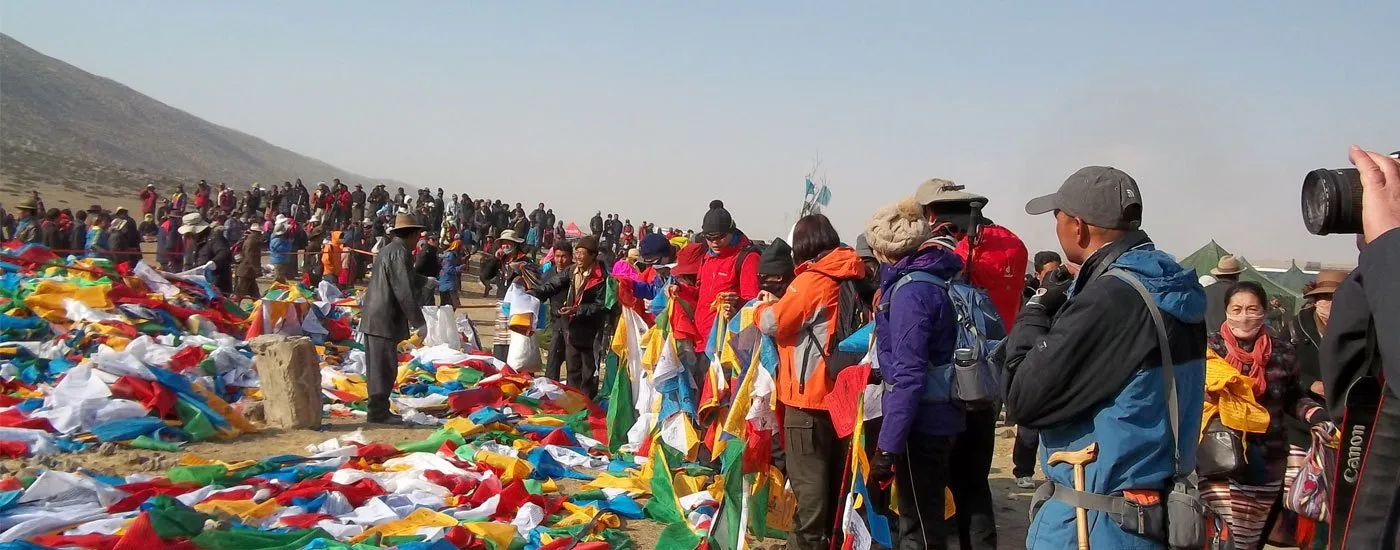
Underneath the vibrant, outward celebrations runs a deeper, quiet theme: the lesson of impermanence, or anicca. The festival itself is structured to act as an active pedagogical tool a "school of letting go". Every physical element of the festival visually reinforces this concept :
Tens of thousands of clarified butter lamps (kar me) are lit, burning with a brilliant, steady glow before quietly vanishing into darkness. Intricately carved, sacred sculptures of colored butter are displayed in monasteries, only to melt away naturally as the weather warms. Highly vibrant, colorful cotton flags are strung across windy mountain passes, quickly fading, fraying, and returning to the elements within a single season of Himalayan wind. Devotees treat these transient states not with sadness, but as direct reminders that even the greatest spiritual teacher was subject to the law of decay, encouraging observers to accept the fleeting nature of existence and cultivate non-attachment.
The Economy of Merit: Ethical Restraint and Monastic Vows
Saga Dawa is often referred to in the Himalayan region as Bumgyur Dawa, which translates to the "month of multiplication". This name stems from the absolute belief that during this sacred month, the karmic consequences of all actions both virtuous and non-virtuous are multiplied exponentially. According to traditional monastic teachings, any merit accumulated through positive deeds is multiplied by 100,000 times on ordinary days of the month. On the climactic full moon day, known as Saga Dawa Düchen (the "great occasion" of the fourth month), the multiplication factor is believed to reach even higher magnitudes. This spiritual equation can be modeled mathematically as:
Kv = A x 10(5)
where Kv represents the accumulated karmic value, and A represents the standard weight of a virtuous deed performed on an ordinary day outside the sacred month. When Saga Dawa coincides with astrologically auspicious years, such as the Year of the Horse in the Tibetan calendar (as observed in 2026), the spiritual impact of these deeds is believed to compound further. During these specific cycles, the multiplication is traditionally described as folding 13 times, offering a rare opportunity for devotees to purify lifetimes of negative karma. This belief shifts the behavior of entire communities, prompting a collective focus on ethical discipline, non-violence, and spiritual devotion.
To generate this spiritual wealth, lay practitioners adopt rigorous monastic disciplines. The most common forms of self-restraint are the observation of the Eight Mahayana Precepts and the participation in the grueling Nyungne fasting ritual. These practices are structured to cleanse bodily, verbal, and mental transgressions through voluntary suffering and absolute mindfulness.
| Metric | The Eight Mahayana Precepts | The Nyungne Fasting Ritual |
| Duration |
Observed for a single 24-hour period (often on Saga Dawa Düchen). |
Conducted as a strict two-day silent spiritual retreat. |
| Dietary Rules |
No consumption of food after midday (noon). |
Complete abstention from all food and water on the second day. |
| Behavioral Codes |
Abstaining from killing, stealing, sexual activity, lying, and intoxicants. |
Strict, unbroken silence and withdrawal from all public interaction. |
| Sensory Restraint |
No singing, dancing, playing music, wearing jewelry, perfume, or makeup. |
Complete mental internalization and focus on physical purification. |
| Physical Comforts |
No sitting or sleeping on high, luxurious, or elevated beds and seats. |
Continuous prostration and physical chanting of mantras. |
Urban Devotion: Lhasa and the Centers of Tibetan Exilic Worship
The celebration of Saga Dawa manifests with unique intensity within major urban centers, where dense populations of devotees coordinate their movements to create rivers of continuous circumambulation. In Tibet, the capital city of Lhasa serves as the urban epicenter of this devotional energy. Pilgrims flock to major historical monasteries like Samye, Tashilhunpo in Shigatse, and the central monuments of Lhasa to perform the kora, or ritual walking circuit.
In Lhasa, the kora takes three forms arranged as concentric circles around the Jokhang Temple. One key circuit is the outer road (Lingkhor), which takes days for pilgrims performing full-body prostrations, and the middle ring (Barkhor). Devotees circumambulate the Jokhang Temple, the Potala Palace, and individual neighborhood shrines.
After completing their rigorous morning and midday koras, the local populace spends the late afternoon picnicking in Dzongyab Lukhang Park, situated directly at the foot of the Potala Palace. Within this park, a temple on the islet of the Dragon King Pond serves as a site where sacrifices and offerings are made to the local female deity. This is accompanied by festive boating and social gatherings, showing how sacred devotion blends with natural celebration.
This urban pattern of devotion is closely mirrored outside Tibet. For the Tibetan exilic community, the Boudhanath Stupa in Kathmandu, Nepal, represents the central axis of the sacred month. As one of the largest stupas in the world, Boudhanath becomes a site of constant activity. Throughout the month, and especially on the full moon day of Saga Dawa Düchen, the circular plaza surrounding the stupa is filled with a continuous, clockwise flow of pilgrims. At dusk, the entire circle is illuminated by tens of thousands of glowing butter lamps, and the surrounding gompas (monasteries) reverberate with deep chanting late into the night, creating a powerful sensory experience.
The Ritual Axis: The Tarboche Flagpole Ceremony of Mount Kailash
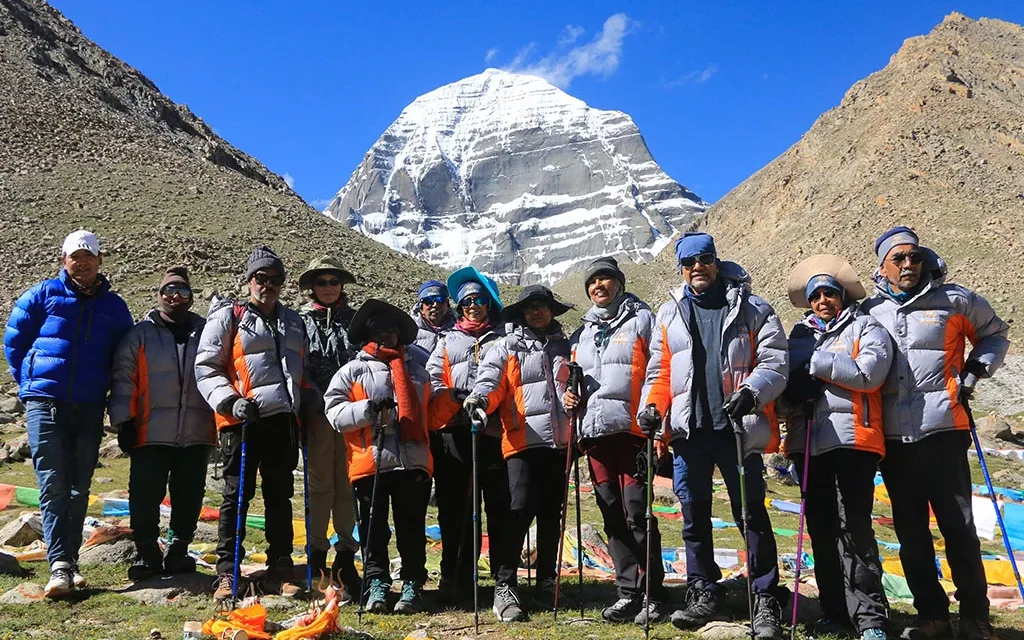
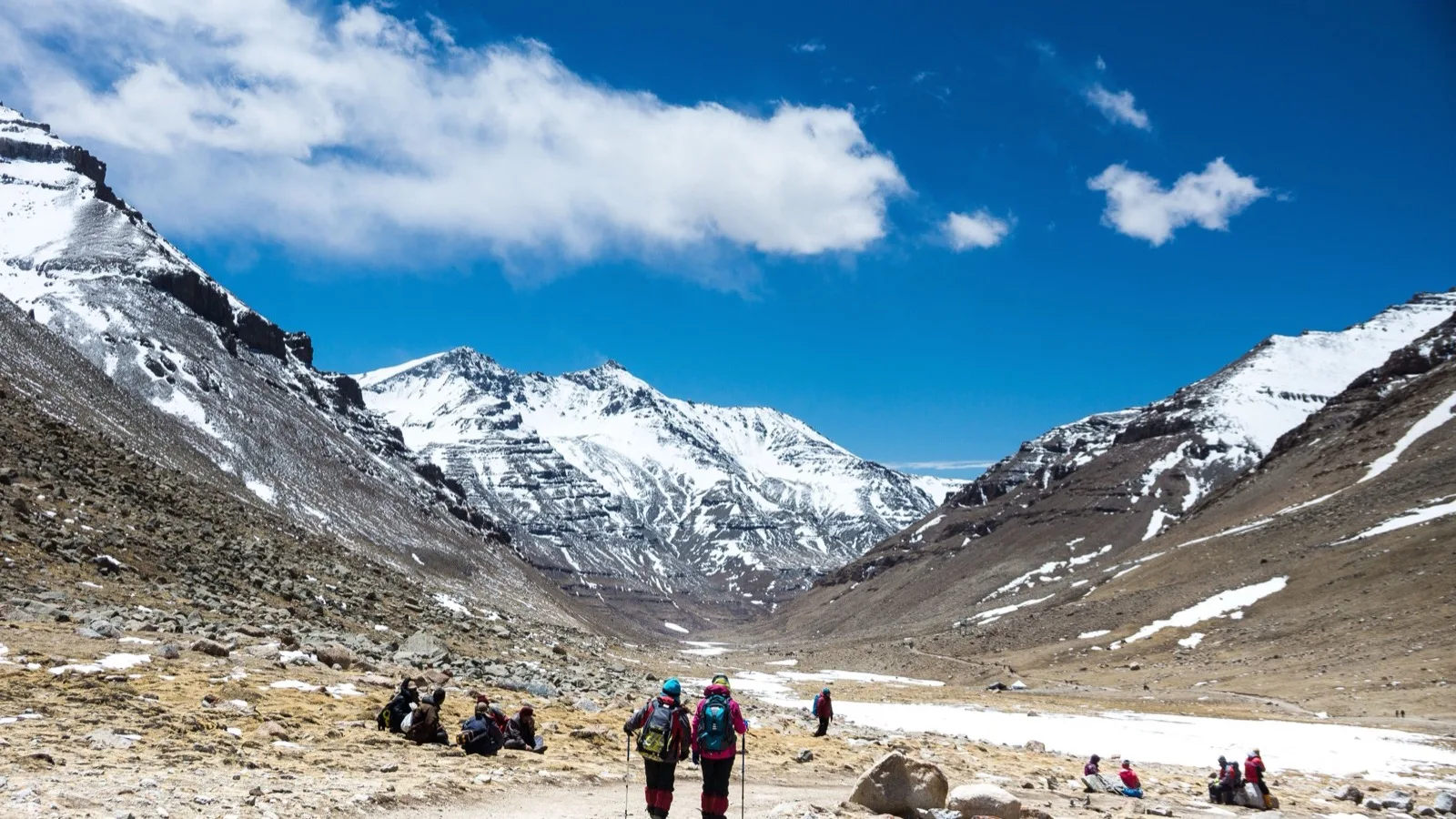
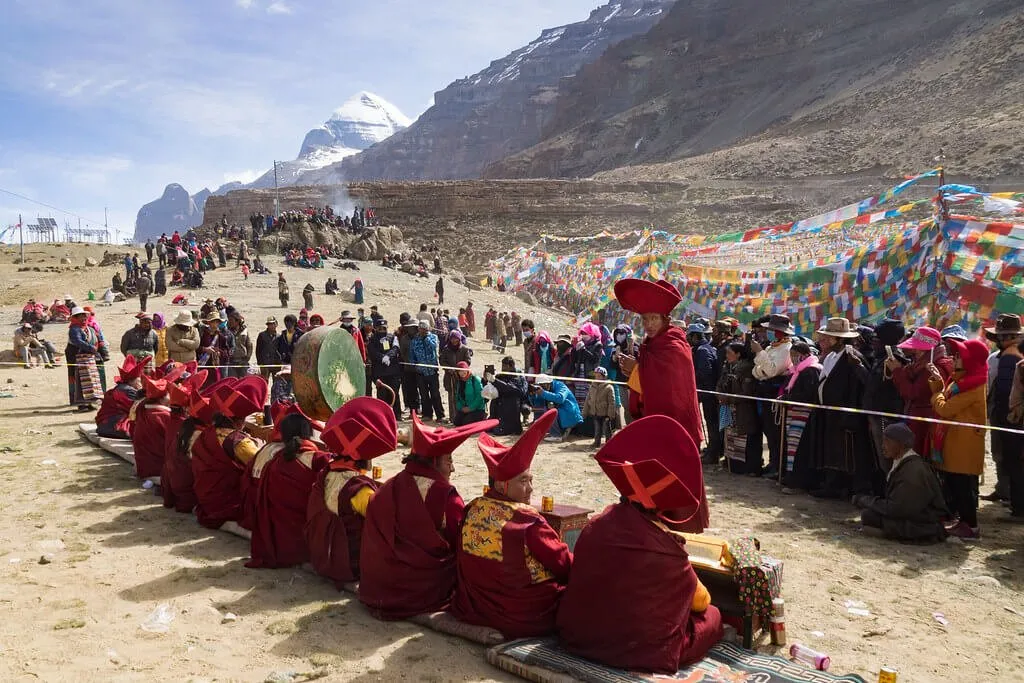
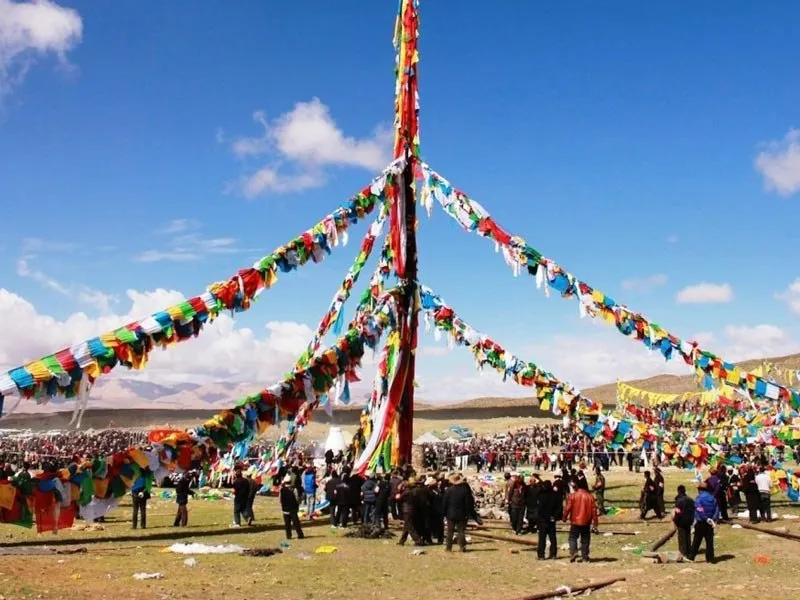
The absolute geographic and spiritual highlight of the Saga Dawa Festival is the remote Tarboche valley, situated at the base of Mount Kailash. Marked by the sacred Yamdwar Temple, this high-altitude valley serves as the official starting point of the grueling 52-kilometer trekking circuit known as the Kailash Kora. On the full moon day, thousands of nomads, pilgrims, monks, and foreign observers gather in the valley to witness and assist in the raising of the Tarboche Flagpole, a 25-meter-tall wooden pillar draped in thousands of colorful prayer flags (Lungta).
The raising of the flagpole is a long, highly coordinated physical process that takes several days to slowly jack up. Each year, the old flagpole is lowered, and a new one is prepared with fresh flags brought by pilgrims from their homes. In a highly animated display, traditional horsemen dressed in elaborate costumes race around the rising flagpole, creating an intense, joyful, and chaotic atmosphere.
For those unable to complete the full, challenging 52-kilometer trek around Mount Kailash, local beliefs dictate that performing 13 circumambulations of the Tarboche flagpole is spiritually equivalent to one complete circumambulation of the mountain, granting immense purification.
Once the pole is upright, the crowd interprets its alignment. A pole leaning toward Mount Kailash brings prosperity and spiritual growth, whereas a crooked or outward-leaning pole is treated as an omen of incoming challenges.
Regional Geographies: Processions in Sikkim and the Hanle Valley
In the Indian state of Sikkim, where Saga Dawa is celebrated as an official state holiday, the mountain capital of Gangtok becomes a focal point of public devotion. The primary event in Gangtok is The Grand Holy Book Procession, which starts from the býval Royal Chapel at Tsuklakhang Monastery.
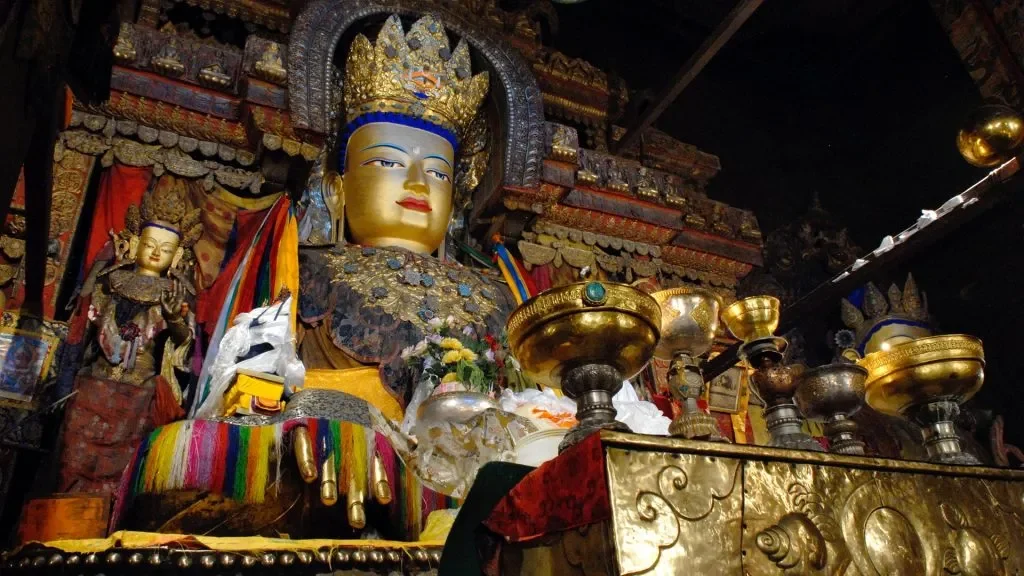
Beginning at 8:00 AM on the day of the full moon and concluding by midday, this public parade features ordained monks carrying the 108 volumes of the Kangyur - the direct, spoken teachings of the Buddha - wrapped in yellow silk cloth on their shoulders through the streets. The procession is accompanied by the deep tones of long dungchen horns and traditional Sikkimese wind instruments, while lay devotees bow respectfully to touch their foreheads to the holy scriptures as they pass.
Nearby, the historic Rumtek Monastery hosts special prayers and sacred mask performances (Chaam) by Karma Kagyu monks, providing a visual feast of monastic dance.
[ Hanle Valley Hamlets ] (Punguk, Khuldo, Naga, Shado, Bhok, Zhingsoma)
             |
             v (Joint Coordination under Sonam Dorje)
 (Buddha Statue Placed on Decorated Vehicle)
             |
             +---> [ Khuldo Hamlet ] (Refreshments: Buns, Cold Drinks, Salt Tea)
             |
             +---> (Monastic Prayers and Circumambulating Mountains)
             |
             +---> (Blessings Given to Local Residents via Holy Scrolls)
             |
             v
[ Naga Grasslands End ] (Final Prayers and Ceremonial Horns)
In sharp contrast to the urban parades of Gangtok, the celebrations in Ladakh, particularly in the remote Hanle River Valley, illustrate how the festival builds community bonds in remote regions. Hanle, a high-altitude area with a population of 1,879, is home to scattered pastoral communities.
- Historically, individual families and tiny hamlets celebrated Saga Dawa in isolation. Today, six distinct, sparsely populated hamlets Punguk, Khuldo, Naga, Shado, Bhok, and Zhingsoma joined forces to host a coordinated procession. This collaborative effort was led by Sonam Dorje, the head of the organizing committee who also works at the Indian Astronomical Observatory in Hanle.
- The Hanle procession begins at 8:00 AM at the local monastery, where a sacred statue of the Buddha is carefully placed on top of a decorated matador van, turning it into a mobile chariot. Led by lamas wearing traditional red caps and playing traditional wind instruments the shorter gelling and the longer, deep-toned tung the convoy journeys across the rough mountain valley floor.
- Women dressed in traditional wool gowns called sulma and nelen hats carry the holy scripture scrolls on their shoulders over mountain paths, streams, and grasslands. Along the route, residents of Khuldo set up rest stations offering buns, cold drinks, and traditional salt tea.
- The procession stops at Bug village, where locals gather to seek blessings from the holy scrolls before the journey concludes in the grasslands of Naga, accompanied by ceremonial drums and horns.
Ethnographic Guidelines: Cultural Etiquette and Sacred Protocols for Observers

Because Saga Dawa is an active period of deep spiritual practice rather than a performance for tourists, visitors must follow strict cultural guidelines. Showing respect for the local culture ensures that these sacred traditions remain protected and welcoming to all.
| Etiquette Domain | Respectful Action (Do) | Restricted Action (Don't) |
| Sacred Landscapes |
Walk clockwise around stupas, monasteries, and mani walls. |
Do not walk counter-clockwise around Buddhist monuments. |
| Monastic Spaces |
Remove hats, sunglasses, and shoes when entering temple halls. |
Do not smoke, flip through scriptures, or strike bells and drums. |
| Social Etiquette |
Wait for hosts to serve traditional butter tea with both hands before accepting. |
Do not touch anyone's head, including children's, as it is highly disrespectful. |
| Nomadic Territories |
Greet locals with "Tashi Delek" and ask before approaching private tents. |
Do not enter tents, touch animals, or approach Tibetan mastiffs without invitation. |
| Media & Photography |
Seek explicit permission before photographing pilgrims or monks in prayer. |
Never point cameras at military personnel, checkpoints, or border installations. |
| Ethical Conduct |
Observe strict vegetarianism and participate in releasing captive animals (Tsethar). |
Avoid killing any living being, using intoxicants, or initiating sensitive political topics. |
Keep Reading
View All Articles-
Playing Holi with Butter at Dayara Bugyal Holi in the monsoon
Playing Holi with Butter at Dayara Bugyal Holi in the monsoon, and with only butter and curd milk as the colours! Well, there is no need for us to be surprised.
-
Diwali Significance, History & 5-Day Festival Guide
Explore the spiritual meaning, myths, and history of Diwali. Discover the significance of the 5-day celebration of the festival of lights
-
Dussehra Festival in India : Celebrations in Almora, Kullu, and Mysore
Dussehra, also known as Vijayadashami, is one of India’s most celebrated festivals, symbolizing the victory of good over evil. This article explains the meaning of Dussehra, its connection with Navratri, Ramayana, and the defeat of Mahishasura, along with traditional customs followed across Indian states.