



Festival & Utsav
Jagannath Rath Yatra 2026 in Puri Odisha
The annual Jagannath Rath Yatra in Puri, Odisha, represents one of the most culturally significant and logistically massive religious congregations in the world.
 By Spiritual Yatra
15 min read
By Spiritual Yatra
15 min read
Jagannath Rath Yatra 2026 in Puri: Live Darshan, Chariot Pulling, and Pilgrimage Package Guide
The annual Jagannath Rath Yatra in Puri, Odisha, represents one of the most culturally significant and logistically massive religious congregations in the world. Centered around the grand journey of Lord Jagannath, his elder brother Lord Balabhadra, and their sister Devi Subhadra, this chariot festival is a profound manifestation of devotion, universal equality, and public celebration. In mid-July 2026, the coastal city of Puri will witness an influx of hundreds of thousands of pilgrims, alongside millions of global viewers participating via live broadcasts.
Following critical crowd-safety challenges during the 2025 festival, the Odisha state administration has enacted a highly structured, capacity-capped crowd management model for 2026. This Article provides an exhaustive, expert-level analysis of the 2026 festival, detailing the exact ritual timeline, the intricate engineering and iconography of the holy chariots, the state's public safety framework, remote live darshan options, and a comprehensive guide to travel and lodging packages.
Historical Foundations and Scriptural Origins
The origins of the Jagannath Rath Yatra are deeply embedded in ancient Hindu scriptures, with extensive documentation found in the Skanda Purana, the Brahma Purana, and the Narada Purana. According to Hindu tradition, the festival's history is tied to King Indradyumna of Malwa, who received a divine vision directing him to the coast of Puri, where a sacred log had washed ashore. The divine craftsman Vishwakarma appeared in disguise to carve the forms of the deities from this sacred wood on the condition of absolute privacy. However, the impatient king opened the chamber doors prematurely, causing the craftsman to vanish. Left behind were three incomplete wooden forms without fully shaped arms or legs, which a divine voice subsequently instructed the king to install and worship as the living deities of the universe.
This historical continuity has remained unbroken for over a thousand years, preserved by specialized hereditary servitor communities in Puri, such as the Daitas and Suaras. The magnitude of the festival has historically captured the attention of global observers, with the 13th-century Venetian traveler Marco Polo documenting a massive chariot procession in India, which historians widely identify as the Puri Rath Yatra. In the 16th century, the prominent Vaishnava saint Sri Chaitanya Mahaprabhu made Puri his home, participating in the chariot pulling with extraordinary ecstasy and cementing the festival's spiritual stature across India.
A defining theological aspect of the festival is the concept of radical openness and universal integration. While entry into the inner sanctum of the 12th-century Jagannath Temple is traditionally restricted to Hindus, the Rath Yatra represents a divine descent where the deities emerge from the temple to make themselves fully accessible to all individuals, regardless of caste, religion, gender, or social background. The physical form of Lord Jagannath, carved from neem wood and known as Darubrahman ("The Sacred Wood-Riddle") or Chakaakhi ("With round eyes"), represents an abstract deity that steps into the public domain to meet humanity where they are.
Chronological Timelines and the 2026 Ritual Calendar
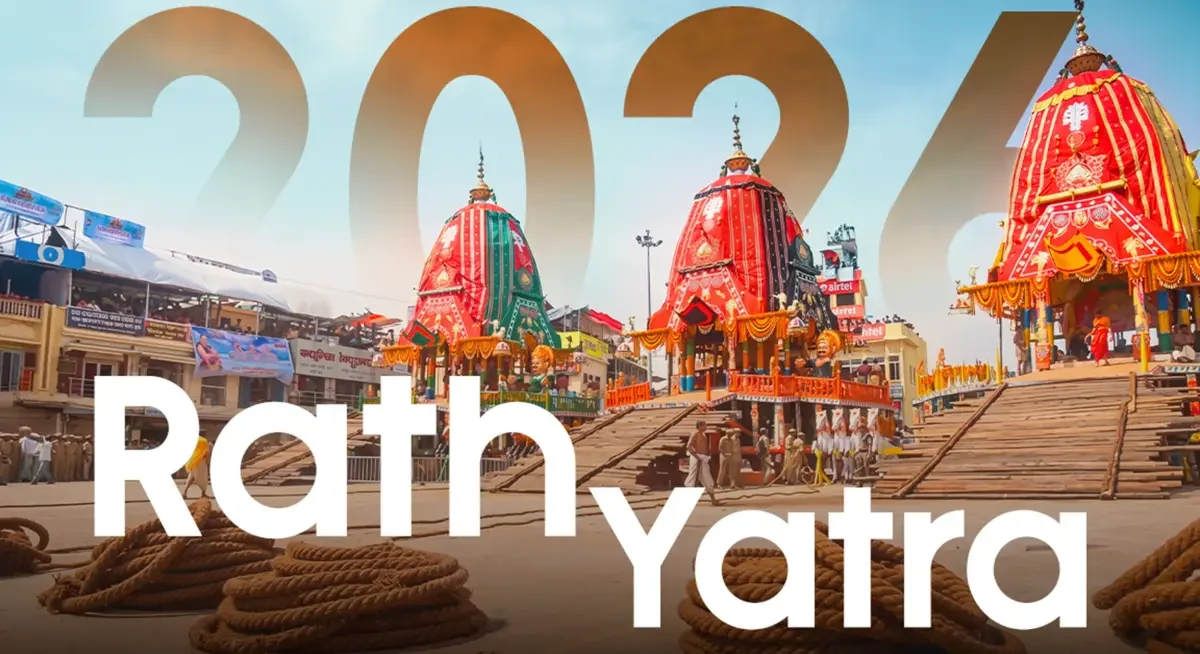
The scheduling of the Rath Yatra is determined annually based on the Hindu lunisolar calendar. The festival commences on the Dwitiya Tithi (second lunar day) of the Shukla Paksha (bright fortnight) in the month of Ashadha. In 2026, the main chariot procession begins on Thursday, July 16, 2026.
A critical planning consideration for global travelers is the discrepancy found in several regional travel portals and commercial blogs, which erroneously advertise the 2026 Yatra for June 16, 2026. Authentic temple calendars and astronomical calculations confirm that the Dwitiya Tithi starts on July 15, 2026, at 11:50 AM and ends on July 16, 2026, at 8:52 AM, designating July 16, 2026, as the official start of the chariot procession. The return journey, known as the Bahuda Jatra, is scheduled for Friday, July 24, 2026.
The festival is not a single-day event but a continuous, 9-day cycle of highly choreographed rituals that begin weeks in advance:
|
Ritual Event |
Scheduled Date in 2026 |
Spiritual and Practical Significance |
|
Snana Purnima |
June 29, 2026 |
The ceremonial bathing of the deities with 108 pitchers of aromatic water, marking their birthday. |
|
Anavasara (Anasara) |
June 29 – July 14, 2026 |
A 15-day period of absolute seclusion. The deities are believed to suffer from a high fever post-bath; the temple is closed to the public. |
|
Netrotsava & Nabajoubona Darshana |
July 15, 2026 |
The solemn day when the deities are freshly repainted and rejuvenated, allowing devotees their first glimpse (darshan) after seclusion. |
|
Gundicha Marjana |
July 15, 2026 |
The ritual cleansing of the Gundicha Temple (the deities' destination) by devotees and servitors to prepare for the arrival. |
|
Rath Yatra (Procession) |
July 16, 2026 |
The main chariot pulling day. The deities leave the Jagannath Temple to travel 3 kilometers down the Grand Road (Bada Danda) to the Gundicha Temple. |
|
Hera Panchami |
July 20, 2026 |
Goddess Lakshmi secretly visits the Gundicha Temple to express her anger at being left behind, symbolically damaging Balabhadra’s chariot. |
|
Sandhya Darshan |
July 22, 2026 |
A highly auspicious evening viewing of the deities while they reside at the Gundicha Temple, believed to grant immense spiritual merit. |
|
Bahuda Yatra |
July 24, 2026 |
The return chariot procession. The deities travel back toward the main Jagannath Temple. |
|
Suna Besha |
July 25, 2026 |
The deities are adorned in massive gold ornaments weighing several hundred kilograms while remaining on their chariots outside the Lion's Gate. |
|
Adhara Pana |
July 26, 2026 |
A ritual offering of a sweet, aromatic drink poured from large clay pots, which are then broken on the chariots to liberate resident spirits. |
|
Niladri Bije (Bijay) |
July 27, 2026 |
The concluding ritual where the deities are escorted back into the inner sanctum of the main temple, ending the public festival. |
The journey is rooted in a domestic narrative where Goddess Subhadra expressed her desire to visit her aunt’s residence at the Gundicha Temple. Her brothers, Lord Jagannath and Lord Balabhadra, accompanied her on the chariot ride to fulfill her wish. During their return journey, the deities halt at the Mausima Temple to accept Poda Pitha, a traditionally baked rice-and-lentil cake offered to the deities to sustain their journey.
Sacred Engineering and Chariot Specifications
A profound aspect of the Jagannath tradition is the nature of the deities themselves. Carved in an abstract, non-standard iconographic style from sacred neem wood (daru brahma), these wooden forms must be periodically remade. This ritual recreation of the wooden bodies is called Nabakalebara. While some online travel literature confuses the annual chariot construction with Nabakalebara , historical and temple records indicate that the next Nabakalebara will not occur until 2034, with the last having taken place in 2015.
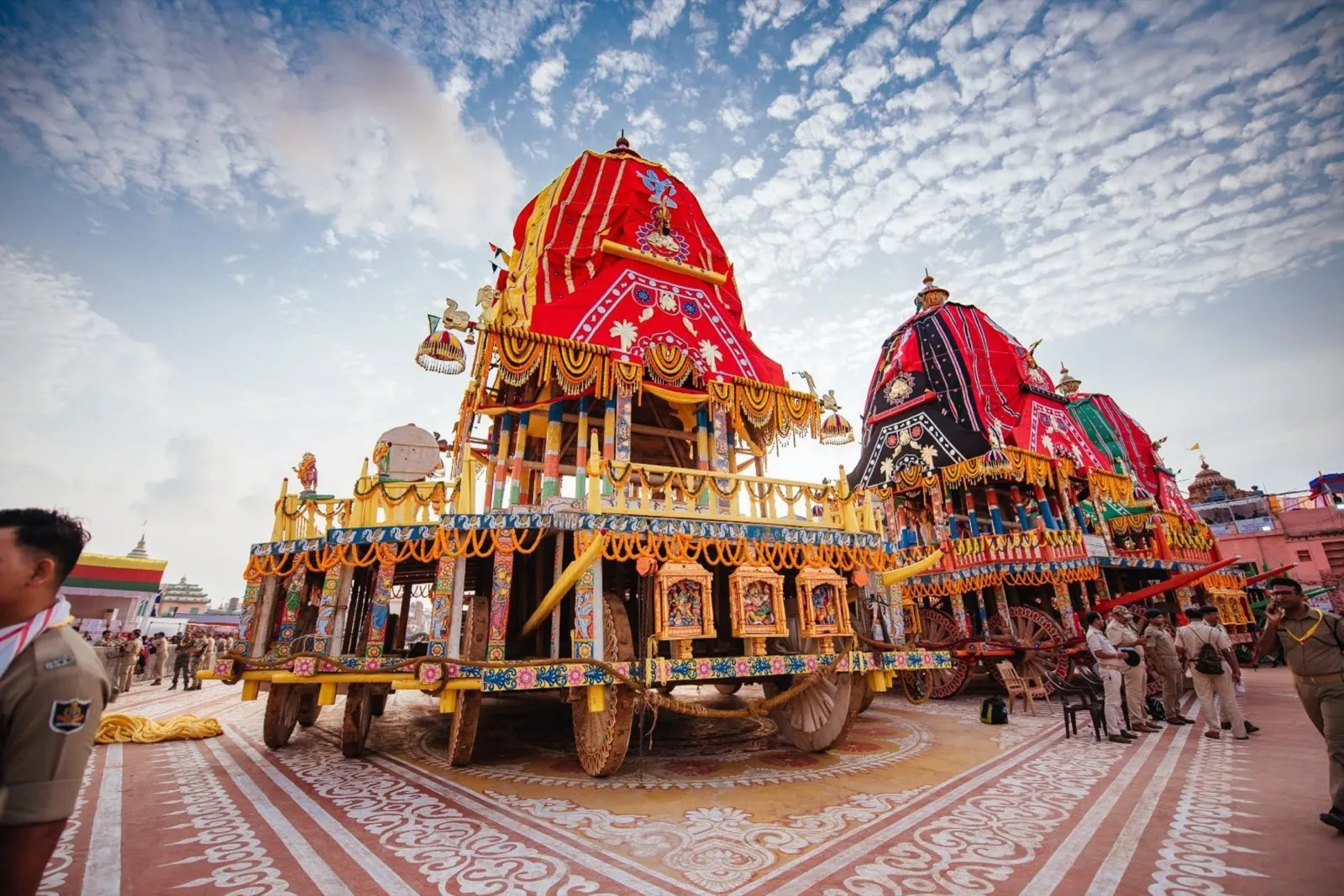
Every year, however, three massive wooden chariots are built entirely from scratch. This represents a masterpiece of medieval architectural engineering, utilizing over 4,000 pieces of wood and executed by hereditary craftsmen known as Maharana Sevayats. The construction is completed without a single metal nail, relying entirely on complex joinery, wooden pegs, and coconut-fiber ropes.
Each of the three deities travels in a structurally distinct chariot, decorated with highly specific color schemes, flags, and symbolic guardians:
|
Iconographic Component |
Lord Jagannath: Nandighosha |
Lord Balabhadra: Taladhwaja |
Devi Subhadra: Darpadalana |
|
Alternative Names |
Garudadhwaja, Kapidhwaja, Chakradhwaja |
Langaladhwaja |
Devadalana, Padmadhwaja |
|
Total Height |
45 feet (13.5 meters) |
44 feet (13.2 meters) |
43 feet (12.9 meters) |
|
Base Dimensions |
34.6 feet x 34.6 feet |
33 feet x 33 feet |
31.6 feet x 31.6 feet |
|
Wheel Count & Size |
16 wheels; 7.0 feet diameter |
14 wheels; 6.5 feet diameter |
12 wheels; 6.0 feet diameter |
|
Canopy Fabrics |
Red and Yellow cloth (representing Vishnu) |
Red and Bluish-Green cloth |
Red and Black cloth (representing Shakti) |
|
Wooden Pieces Used |
832 pieces |
763 pieces |
593 pieces |
|
Charioteer (Sarathi) |
Daruka |
Matali |
Arjuna |
|
Flag Name & Emblem |
Trailokyamohini (Hanuman emblem) |
Unnani (Palm tree emblem) |
Nadambika |
|
Horses (Color & Name) |
4 White (Shankha, Balahaka, Shveta, Haridashva) |
4 Black (Tibra, Ghora, Dirghashrama, Swarnanava) |
4 Red (Rochika, Mochika, Jita, Aparajita) |
|
Sacred Pulling Rope |
Sankhachuda |
Basuki Naga |
Swarnachuda |
|
Primary Weapons |
Shankha and Chakra |
Hala and Musala |
Padma and Kalhar |
|
Gatekeepers |
Jay and Vijay |
Nanda and Sunanda |
Ganga and Jamuna |
|
Divine Guardians |
Garuda / Narasimha |
Vasudev |
Jayadurga |
|
Unique Specifics |
Dadhinauti: Hiranya Garva; Parrots: Jiba & Parama |
Face of Chariot: Ketu Bhadra |
Face of Chariot: Bhakti Sumedha |
Philosophically, this chariot procession operates as a powerful physical metaphor derived from the Katha Upanishad. The chariot represents the physical body; the deity represents the individual soul (Atman); the charioteer represents the intellect (Buddhi); and the reins symbolize the mind (Manas). The collective physical act of pulling these massive structures signifies the soul's deliberate journey toward spiritual liberation and alignment with cosmic order.
Administrative Crowd Management and Security Infrastructure
The 2026 Rath Yatra marks a paradigm shift in how the Odisha state government and the Shree Jagannath Temple Administration approach public safety. This transition is a direct administrative response to the tragic events of June 29, 2025, when a sudden crowd surge near the Gundicha Temple during the charamala (the dismantling of the wooden ladders used to lower the deities) resulted in a stampede that claimed three lives and injured fifty others.
To eliminate high-pressure crowd dynamics, the government has moved from a model of unrestricted public access to a strict carrying-capacity limitation model.
The Bada Danda Spatial Carrying Capacity Model
Puri’s Grand Road (Bada Danda) connects the Jagannath Temple to the Gundicha Temple. The road has a length of 2.5 km (2500 meters). The width of this arterial corridor varies from 35 meters to 105 meters, with a calculated average width of 50 meters.
Using standard spatial safety metrics for dynamic, moving crowd events—which recommend a maximum density of 3 individuals per square meter (3 people/m2) to prevent shockwave propagation and crushing hazards the total safe capacity of the Grand Road is calculated as follows:
Total Area (A) = 2500 m x 50 m = 125,000 m2
Safe Carrying Capacity (C) = 125,000 m2 x 3 people m2 = 375,000 people
Historically, the Grand Road has regularly been forced to absorb between 700,000 and 1,000,000 individuals during peak chariot pulling hours, resulting in dangerous fluid-crowd densities exceeding 6 people per square meter. For 2026, the state has capped the Grand Road's active capacity at a maximum of 3.5 to 4 lakh (350,000 to 400,000) individuals at any single point in time.
To enforce this cap, a newly formed multi-agency committee headed by Chief Secretary Anu Garg, Puri District Collector Dibyajyoti Parida, and SP Prateek Singh has implemented several major operational interventions :
- Inflow Regulation: Real-time caps will be enforced on inbound pilgrim transport, with transport authorities regulating the hourly arrivals of trains, interstate buses, and private vehicles into Puri.
- Commercial Relocation: To prevent physical bottlenecks, all NGO-run free food stalls and water distribution centers have been banned from the Grand Road and relocated to designated open spaces, such as the Jagannath Ballav parking zone.
- Restricted Moving Zones: Performing dance troupes and cultural teams are prohibited from assembling in the immediate vicinity of the moving chariots. Only verified medical teams, fire services, and trained evacuation volunteers are allowed in the frontline zones.
- No Heavy Vehicles: Water-sprinkling trucks and media logistics vehicles are completely banned from entering the active crowd zone.
- The "Charamala" Separation: A separate physical barricading and scheduling protocol has been established specifically for the lowering of the deities via the wooden ladders, separating the servitors from the public to prevent localized surges.
- Smart Security Infrastructure: An Integrated Command Control Centre has been established, linking high-definition CCTV systems extending from Uttara Chhak all the way to the Grand Road.
Multi-Platform Live Darshan Coordination
To alleviate physical crowd pressure on Bada Danda, the state is actively promoting "digital darshan" through high-definition television and digital broadcasts. This enables millions of global devotees to view the highly sacred rituals without adding to the physical safety burden on-site.
Official broadcasting networks and access coordinates for 2026 include:
- Doordarshan National & DD Odia: The primary state broadcasters providing multi-camera, high-definition live telecasts of all major rituals, including the Pahandi (the ceremonial procession of the deities to the chariots) and the chariot pulling.
- News18 Odia: Presenting a comprehensive 15-day broadcasting campaign, featuring 35 hours of specialized historical programming and 12 hours of uninterrupted live coverage on the main Yatra day. The channel will feature specialized analysis from heritage scholars and focus on the contributions of the Sevayats—including the carpenters, blacksmiths, painters, and tailors.
- OdishaTV (OTV): Odisha’s premier private satellite network, offering continuous live feeds on terrestrial television and global digital platforms.
- Official Temple Digital Portals: Live webcasts are hosted directly on the Shree Jagannath Temple Administration’s official website and dedicated mobile applications, offering remote, uninterrupted feeds of the inner courtyard and chariot platforms.
Strategic Travel Planning and Pilgrimage Package Directory
Due to the extreme demand for accommodation and transit during the mid-July peak, booking pilgrimage packages and lodging months in advance is essential. For 2026, several vetted public and private operators are offering specialized travel packages that integrate transport, lodging, guided access, and safe viewing arrangements.
Private Heritage and Rooftop Packages
The standard 3-Day Ryask Tourism itinerary is detailed below:
- Day 01: Arrival at Bhubaneswar or Puri; transfer to hotel; afternoon excursion to the UNESCO World Heritage Konark Sun Temple, the ASI Museum, and Chandrabhaga Beach; dinner and overnight stay.
- Day 02 (Rath Yatra Day): Early morning transfer to Bada Danda; full-day viewing from a secured rooftop location; packed breakfast and bottled water provided; evening return to the resort.
- Day 03: Breakfast, check-out, and transfer to Puri Railway Station or Bhubaneswar Airport.
The per-head pricing for private packages is highly dependent on group size and the vehicle tier utilized:
|
Guest Capacity |
Vehicle Category |
Per Head Cost (INR) |
Key Package Inclusions |
|
2 Guests |
Sedan (Swift Dzire) |
₹24,900 |
2 Nights deluxe lodging, airport transfers, Konark excursion, expert guide, dedicated Bada Danda transfers. |
|
4 Guests |
Sedan (Swift Dzire) |
₹15,000 |
2 Nights deluxe lodging, shared sedan transport, breakfast, transfers, Konark excursion. |
|
4 Guests |
SUV (Toyota Innova) |
₹16,800 |
2 Nights luxury lodging, premium SUV transport, airport transfers, guided temple viewing. |
|
6 Guests |
SUV (Toyota Innova) |
₹15,100 |
Shared premium SUV transport, 2 nights deluxe lodging, breakfast, transfers. |
|
10 Guests |
Tempo Traveller |
₹14,580 |
Group dynamic pricing, spacious vehicle, deluxe twin-sharing rooms, comprehensive transfers. |
|
12 Guests |
Tempo Traveller |
₹14,100 |
Optimized group pricing, dedicated tempo traveller, 2 nights deluxe hotel stay, breakfast. |
Regional Tourism Bundling and Local Sightseeing
Pilgrims often combine their spiritual journey to Puri with regional sightseeing across Odisha's famous Golden Triangle and surrounding eco-tourism sites :
- Bhubaneswar Heritage Sites: Located 60 kilometers north of Puri, the state capital is visited for its 11th-century Lingaraj Temple, Rajarani Temple, and Mukteswar Temple. Additionally, the ancient rock-cut Khandagiri and Udayagiri Jain Caves are highly sought after for their historical carvings dating back to the Emperor Kharavela era.
- Nandankanan Zoological Park: Situated near Kanjia Lake, this sanctuary is renowned for its captive white tiger population and the first captive Gharial crocodile breeding center in India. It offers forest safaris to view blackbucks, panthers, and deer, alongside boating on the lake.
- Chilika Lake (Satapada): Asia’s largest brackish water lagoon is famous for boat cruises to spot the rare Irrawaddy dolphins, Rajhans Island, and the dynamic sea-mouth where the lake meets the Bay of Bengal.
VIP Darshan Protocols and Booking Mechanisms
Navigating the entry requirements for the temple during high-occupancy seasons requires a clear understanding of the ticketing tiers implemented by the Shree Jagannath Temple Administration.
During standard operational days, multiple darshan routes exist to streamline visitor flow. However, during the active Rath Yatra, the inner temple sanctum is completely closed, and darshan must be sought directly on the chariots (Raths) or outside the Gundicha Temple.
|
Darshan Category |
Operational Hours |
Booking Fee (INR) |
Queue Dynamics & Booking Channel |
|
Sarva Darshan |
6:00 AM – 12:00 PM; 4:00 PM – 9:00 PM |
Free |
General public queue. Expect high waiting times; booking opens 3–4 days in advance online. |
|
Special Darshan |
7:00 AM – 12:00 PM; 4:00 PM – 8:00 PM |
₹50 |
Semi-prioritized queue; tickets available via the official web portal or physical temple counters. |
|
Quick Darshan |
7:00 AM – 12:00 PM; 4:00 PM – 8:00 PM |
₹100 |
Fast-track lane; ideal for mid-tier transit times. |
|
VIP Darshan |
7:00 AM – 12:00 PM; 4:00 PM – 8:00 PM |
₹500 |
Maximum priority lane; minimal wait time; personalized assistance; online slots open 1–2 days prior. |
|
Night Darshan |
9:00 PM – 11:00 PM |
₹50 |
Only operational during peak season days; accommodates late-arriving pilgrims. |
Step-by-Step Online Booking Process
- Access the Portal: Visit the official Shree Jagannath Temple Administration website at shreejagannath.org.
- Registration: Complete a user profile with name, valid email address, and active mobile number.
- Select Ticket Details: Choose the preferred darshan category (VIP Darshan at ₹500 is highly recommended for priority access), date, and available hourly slot.
- Enter Pilgrim Details: Provide the full legal name, age, gender, and ID type (Aadhaar, Passport, etc.) for each attendee.
- Secure Payment: Execute the transaction securely using net banking, credit, or debit cards.
- Download Ticket: Print the generated digital ticket containing the barcode required for validation at the temple entry checkpost.
Offline tickets are also available at designated counters near the Main Temple Entrance, the Administrative Office, the Puri Railway Station, and the Puri Bus Stand, operating from 6:00 AM to 12:00 PM and 3:00 PM to 8:00 PM daily.
Puri Hospitality and Lodging Directory
Securing lodging along the Grand Road provides immediate proximity to the rituals but exposes guests to high noise levels and traffic restrictions. Alternatively, staying at premium beachfront resorts slightly away from Bada Danda offers a peaceful retreat, provided that transport transfers are pre-arranged with the hotel.
|
Property Name |
Location & Proximity |
Category & Vibe |
Key Advantages |
|
The Yellow Hotel by Festin |
Grand Road |
Standard / Mid-Range |
Direct proximity; selected rooms offer views of the temple and Grand Road. |
|
Hotel Royal Grand Heritage |
150m from Bada Danda |
Standard / Heritage |
Excellent rooftop restaurant; within walking distance to the core Yatra path. |
|
Panthanivas Puri (OTDC) |
Chakra Tirtha Road |
Government Managed |
Highly secure; managed directly by the Odisha Tourism Development Corporation; excellent local cuisine. |
|
Taj Puri Resort & Spa |
Marine Drive (5.5 miles from temple) |
Ultra-Luxury |
World-class luxury; ocean-facing balconies; high security; ideal for senior citizens and families. |
|
Mayfair Waves & Mayfair Heritage |
Chakra Tirtha Road / Beachfront |
Premium / Luxury |
Private beach access; exceptional spas; highly reliable private transport coordination. |
|
Chanakya BNR Hotel |
Puri Beachfront |
Premium / Colonial Heritage |
Rich history and colonial decor; quiet gardens; renowned hospitality. |
Professional Recommendations for Devotees and Stakeholders
For the State Administration and Municipal Planners
The implementation of the 2026 Carrying Capacity Model represents a mature, modern approach to managing ancient mega-events. However, enforcing a strict cap of 3.5 to 4 lakh people on the Grand Road requires sophisticated, real-time monitoring. It is recommended that the state deploy automated pedestrian-density sensing cameras at all primary entry nodes connecting to Bada Danda.
Furthermore, the permanent security infrastructure built for the festival including the Integrated Command Control Centre and high-mast illumination should be leveraged post-festival to establish Puri as a premier, smart-city heritage destination in South Asia.
For Travel Agencies and Tour Operators
The significant dates discrepancy regarding June vs. July 2026 across secondary travel blogs highlights a systemic risk in religious tourism marketing. Operators must establish direct data-validation pipelines with the Shree Jagannath Temple Administration to protect international clients from booking errors.
Additionally, as safety concerns rise among affluent and elderly demographic segments, the market for "sanitized" pilgrimage products such as private rooftop viewing enclosures with controlled sanitation and catering will continue to grow, justifying further investment in high-vantage real estate partnerships along the Grand Road.
For Prospective Pilgrims and Devotees
The complete closure of the inner temple sanctum during the Rath Yatra and the preceding Anavasara period fundamentally alters the pilgrimage experience. Devotees must understand that a physical journey to Puri during the Yatra is strictly centered on outdoor, public chariot viewing (darshan) rather than traditional indoor temple worship.
For families traveling with children or senior citizens, ground-level participation is highly discouraged due to extreme heat, humidity, and unavoidable crowd surges. Such travelers should prioritize booking premium private packages with secured, elevated rooftop viewing or participate in the festival via the highly coordinated live digital broadcasts.
Keep Reading
View All Articles-
Playing Holi with Butter at Dayara Bugyal Holi in the monsoon
Playing Holi with Butter at Dayara Bugyal Holi in the monsoon, and with only butter and curd milk as the colours! Well, there is no need for us to be surprised.
-
Diwali Significance, History & 5-Day Festival Guide
Explore the spiritual meaning, myths, and history of Diwali. Discover the significance of the 5-day celebration of the festival of lights
-
Dussehra Festival in India : Celebrations in Almora, Kullu, and Mysore
Dussehra, also known as Vijayadashami, is one of India’s most celebrated festivals, symbolizing the victory of good over evil. This article explains the meaning of Dussehra, its connection with Navratri, Ramayana, and the defeat of Mahishasura, along with traditional customs followed across Indian states.